








What's Happening?
Lee Jae-min, a professor of law at Seoul National University, has commented on a new policy issued by the Ministry of Personnel Management that bans dress shoes and ties for government job interviews starting this October. The policy advises against formal
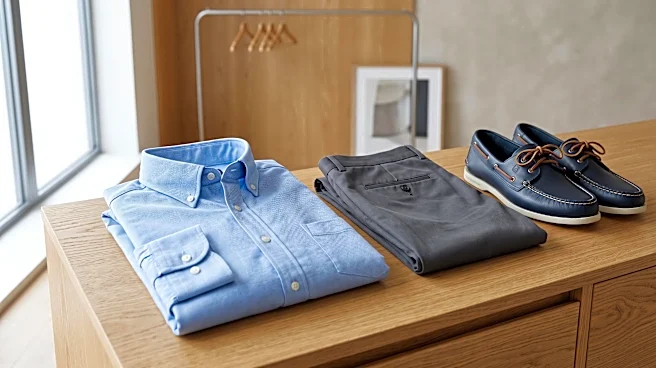
suits and encourages casual attire such as shirts, knits, slacks, chinos, or jeans, paired with sneakers or boat shoes. The stated aim of this change is to alleviate the financial burden on applicants who might otherwise need to purchase or rent formal wear for a single interview. Professor Lee reflects on his own experiences with interview attire dilemmas, noting the long-standing cultural expectation of uniform formal wear in Korean job interviews, where applicants typically aim to blend in rather than stand out. He observes that this cultural norm has been deeply entrenched for decades, with interviewees consistently opting for black or dark gray suits, white shirts, and toned-down accessories.
Why It's Important?
This policy shift is significant because it attempts to disrupt a deeply ingrained cultural practice within the Korean job market, where formal attire has long served as an unwritten equalizer. Professor Lee raises concerns that while the policy is well-intentioned, it might inadvertently create new anxieties for applicants. Instead of reducing stress, candidates may now agonize over what constitutes 'appropriate' casual wear, potentially leading to new forms of social signaling. The professor suggests that removing the uniformity of formal suits could expose socioeconomic disparities among candidates, as personal attire might more loudly reveal financial situations and individual circumstances. This could be particularly detrimental in Korea's highly competitive job market and sensitive social dynamics, potentially undermining the policy's objective of leveling the playing field and creating an unintended ostentation.
What's Next?
The implementation of this new dress code policy will likely lead to a period of adjustment and observation within the Korean job market. Professor Lee anticipates that young applicants will face new dilemmas regarding their attire choices, questioning whether certain brands or styles are too flashy or appropriate. The policy's impact on the perceived fairness and equity of the interview process will be closely watched. If the concerns raised by Professor Lee materialize, there could be calls for further clarification or reconsideration of the policy to ensure it genuinely achieves its goal of reducing applicant burden without introducing new forms of disadvantage. The long-term effects on interview culture and socioeconomic signaling will become clearer as the policy takes root.
Beyond the Headlines
Beyond the immediate practicalities, this policy touches upon deeper societal and cultural dimensions. The traditional emphasis on uniform formal wear in Korean interviews reflects a broader cultural value of conformity and group belonging, where individual expression is often secondary to collective harmony. By encouraging casual wear, the policy implicitly challenges these norms, potentially fostering a more individualistic approach to professional presentation. However, as Professor Lee points out, this shift could also inadvertently highlight class distinctions, transforming what was once a neutral playing field into one where economic background is more visible. This raises ethical questions about how policies intended to promote equity can sometimes have unforeseen consequences, particularly in societies with strong social hierarchies and competitive environments. The debate over interview attire thus becomes a microcosm of larger societal discussions about equality, meritocracy, and cultural change.