



What's Happening?
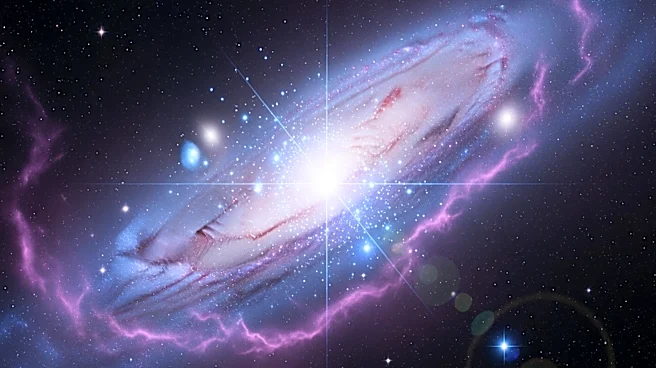
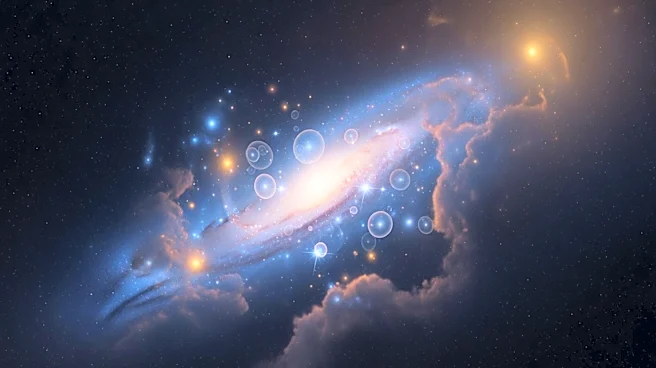
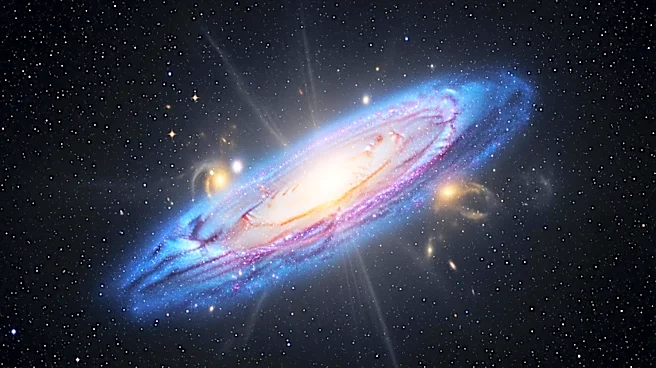
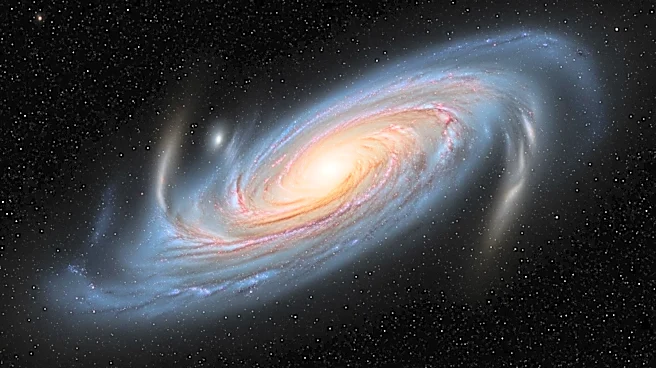
The James Webb Space Telescope has discovered a galaxy, LAP1-B, as it existed 13 billion years ago, just 800 million years after the Big Bang. This galaxy, observed through gravitational lensing, is one of the most chemically primitive galaxies ever detected.
The discovery was made by a team led by Kimihiko Nakajima from Kanazawa University, Japan, and published in Nature. The galaxy's light, magnified by a massive cluster of closer galaxies, revealed a lack of heavy elements and intense ionizing radiation, indicative of the first generation of stars. The findings suggest that LAP1-B is a 'fossil in the making,' providing a rare glimpse into the early stages of galaxy formation.
Why It's Important?
This discovery is crucial for understanding the early universe and the formation of the first stars and galaxies. The James Webb Space Telescope's ability to peer back in time offers insights into the conditions that led to the universe's evolution. The detection of a galaxy with such primitive chemical composition helps scientists study the processes that shaped the cosmos. The findings also provide evidence of Population III stars, the first stars to exist, which are believed to have played a significant role in reionizing the universe. This research enhances our understanding of cosmic history and the origins of galaxies.
Beyond the Headlines
The discovery of LAP1-B not only sheds light on the early universe but also raises questions about the role of dark matter in galaxy formation. The researchers concluded that the galaxy is held together by a massive cloud of dark matter, highlighting its importance in the structure and evolution of galaxies. Additionally, the study of such ancient galaxies can inform models of cosmic evolution and the distribution of matter in the universe. As the James Webb Space Telescope continues to explore the cosmos, it may uncover more about the mysterious dark matter and the universe's earliest epochs.