




What's Happening?
Researchers from EPFL's Microbial Mechanics Lab and Sangwoo Kim's Mechanics of Soft and Biological Matter Laboratory have discovered that the bacterium *Pseudomonas aeruginosa* employs a unique sensory mechanism to navigate crowded environments. This
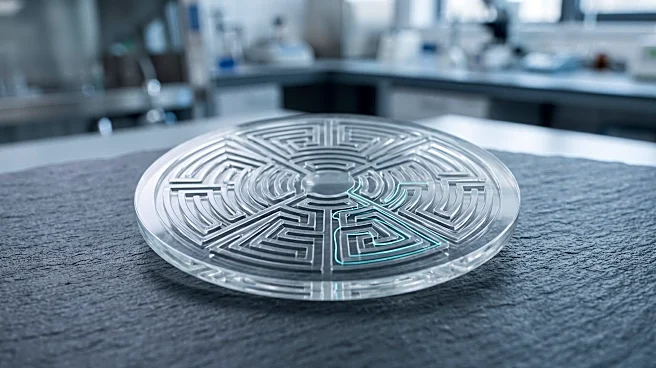
mechanism allows the bacteria to actively modulate their collective organization through touch. When moving on surfaces, these bacteria sense collisions with neighboring cells and respond by reversing direction within seconds. This ability enables the bacterial population to break organized patterns in dense crowds, preventing individuals from getting trapped, while maintaining organization where needed, such as at the edge of a growing colony. The study, published in *Nature Microbiology*, combined live microscopy, single-cell tracking, and computer simulations to compare wild-type bacteria with mutants that lack collision-sensing capabilities. In micro-mazes, only 1% of mutant bacteria reached the exit within four hours, whereas wild-type cells explored an average of 92% of the maze, with 20% reaching the exit.
Why It's Important?
This discovery significantly alters the understanding of bacterial navigation and collective behavior, moving beyond the idea that collective order is merely a passive physical outcome. For the U.S. and global health, this mechanism has critical implications. *Pseudomonas aeruginosa* is a common cause of human infections, particularly in hospital settings, and is known for its ability to form biofilms and spread through host tissues. Understanding how these bacteria navigate and organize can provide new targets for developing strategies to combat infections. By disrupting their navigation and dispersal mechanisms, it might be possible to prevent biofilm formation or limit the spread of these pathogens. Furthermore, the principles uncovered in this study could inspire novel designs for robot swarms, enabling them to navigate complex, crowded, or unknown environments more effectively without becoming stuck, which has applications in various industries from logistics to exploration.
What's Next?
Future research will likely focus on further elucidating the molecular mechanisms behind *Pseudomonas aeruginosa*'s collision-sensing and reversal behavior. Identifying the specific genes and proteins involved in this sensory pathway could lead to the development of targeted antimicrobial agents that interfere with bacterial navigation, rather than directly killing the bacteria, potentially reducing the development of antibiotic resistance. Additionally, researchers may explore whether similar navigation strategies are employed by other pathogenic bacteria, which could broaden the applicability of these findings. In the field of robotics, engineers may begin to incorporate these bio-inspired navigation principles into the design of autonomous swarms, aiming to create more robust and adaptable systems for tasks requiring collective movement in complex spaces. This interdisciplinary approach could lead to advancements in both medical treatments and technological innovations.
Beyond the Headlines
This research delves into the fundamental principles of collective intelligence and self-organization in biological systems. The ability of individual bacteria to process physical interactions (collisions) into sensory information that dictates group behavior highlights a sophisticated level of decentralized control. This has broader implications for understanding how complex behaviors emerge from simple rules at the individual level, a concept applicable across various biological and artificial systems. Ethically, as we gain more control over bacterial behavior, questions may arise about the potential for unintended ecological consequences if such mechanisms are widely manipulated. Legally, intellectual property surrounding bio-inspired robotic navigation systems could become a new area of patent law. Culturally, this discovery reinforces the idea that even the simplest life forms possess intricate and elegant solutions to complex problems, fostering a deeper appreciation for the sophistication of microbial life and potentially influencing how we perceive and interact with the microbial world around us.