


What's Happening?
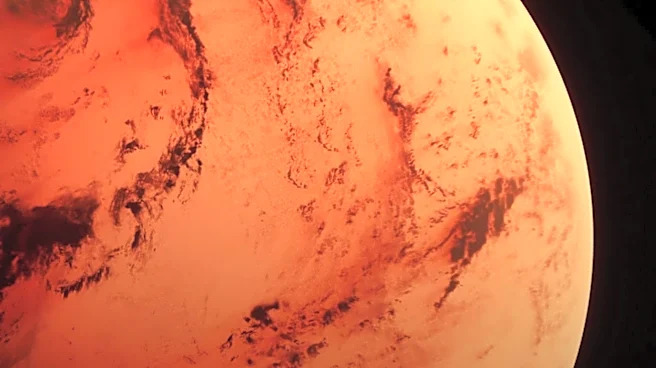
The British Astronomical Association (BAA) has reported continued observations of atmospheric and surface phenomena on Mars as of November 16, 2026. Evening orographic clouds are visible over Ascraeus, Pavonis, and Arsia Mons, as well as Alba Patera in the
northern hemisphere. Clyde Foster captured an image of the Alba cloud on November 7, with the BAA encouraging daily imaging series from observers. These clouds are most prominent in blue or green light. Additionally, bright spots in NW Hellas and Argyre, observed since mid-October, appear to be frost deposits. The Hellas basin typically experiences more widespread frost later in the Martian year, though diurnal cloud can occur at other times. Equatorial cloud cover has also increased, with Frank Melillo's images showing Syrtis Major appearing fainter and bluer towards the evening limb, and white evening cloud noted in Libya/Isidis Regio and parts of Mare Tyrrhenum. The north polar cap is beginning to retreat, with bright spots, possibly indicating faster sublimation, sometimes seen on its southern parts.
Why It's Important?
These ongoing observations by amateur astronomers, coordinated by organizations like the British Astronomical Association, are crucial for understanding the dynamic Martian atmosphere and surface processes. The detailed tracking of cloud formations, frost deposits, and polar cap retreat provides valuable data that complements professional space missions. Such continuous monitoring helps scientists build a more comprehensive picture of Martian weather patterns, seasonal changes, and the distribution of water ice. This information is vital for future Mars exploration, including potential human missions, as it informs decisions about landing sites, resource availability, and environmental hazards. The consistency of observations, with nearly every day in October covered, highlights the significant contribution of the amateur astronomy community to planetary science, demonstrating how ground-based telescopes can still yield important scientific insights into our solar system neighbors.
What's Next?
The British Astronomical Association anticipates continued observations of Mars, with the planet currently at Ls 23 degrees, marking almost a quarter of the way through northern spring. As the Martian year progresses, further changes in the north polar cap, including its retreat and the formation of a summer cap remnant, are expected to be monitored. The Hellas basin is also expected to experience more widespread frost deposition later in the Martian year. Observers will continue to track the equatorial cloud belt, which is anticipated to become more complete around Ls 45 degrees. The BAA encourages observers to maintain their consistent imaging efforts to capture these evolving phenomena, contributing to a continuous record of Martian atmospheric and surface activity. The data collected will be compiled and analyzed to further enhance understanding of Mars's climate and geological processes.
Beyond the Headlines
The consistent and detailed observations of Mars by amateur astronomers, as highlighted by the British Astronomical Association, underscore a broader trend in scientific research: the democratization of data collection and the significant contributions of citizen science. While advanced probes and rovers provide unparalleled close-up data, ground-based observations offer a long-term, continuous perspective on planetary changes that can be difficult for space missions to maintain. This collaborative approach, where amateur enthusiasts contribute to professional scientific understanding, not only enriches our knowledge of Mars but also fosters public engagement with space exploration. It demonstrates that scientific discovery is not solely the domain of large institutions but can be significantly advanced by a global network of dedicated individuals, highlighting the enduring human fascination with the cosmos and the power of collective observation.