
What's Happening?
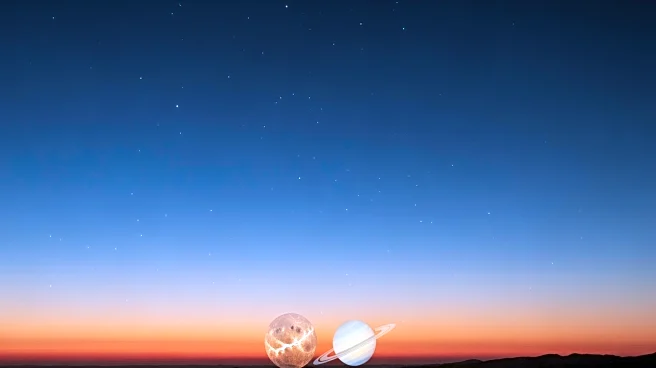
Astronomy Magazine reports that on March 7, 2026, Venus and Saturn will appear close together in the evening sky, providing a unique opportunity for sky watchers. After sunset, Venus will be visible approximately 7 degrees above the horizon, with Saturn located
to its upper left. The magazine suggests using binoculars or a telescope to view Saturn, which is fainter and more distant than Venus. This celestial event allows observers to compare the two planets, noting that Venus appears as a 97-percent-lit gibbous, while Saturn, though farther away, is larger and fully illuminated with its rings visible. The planets will set about 70 minutes after sunset, and the event can be observed again the following day with Saturn appearing south of Venus.
Why It's Important?
This astronomical event is significant for both amateur and professional astronomers as it provides a rare chance to observe two planets in close proximity. Such events can spark public interest in astronomy and encourage educational activities related to space observation. The visibility of Saturn's rings and the comparative analysis of the two planets' appearances can enhance understanding of planetary characteristics and dynamics. Additionally, these events can inspire interest in science and technology, potentially influencing educational and career choices in related fields.
What's Next?
Observers are encouraged to take advantage of this opportunity to view the conjunction on both March 7 and 8, 2026. Astronomy enthusiasts may organize viewing parties or educational sessions to share the experience. The event may also lead to increased interest in upcoming astronomical phenomena, encouraging more people to engage with astronomy as a hobby or field of study.