

What's Happening?
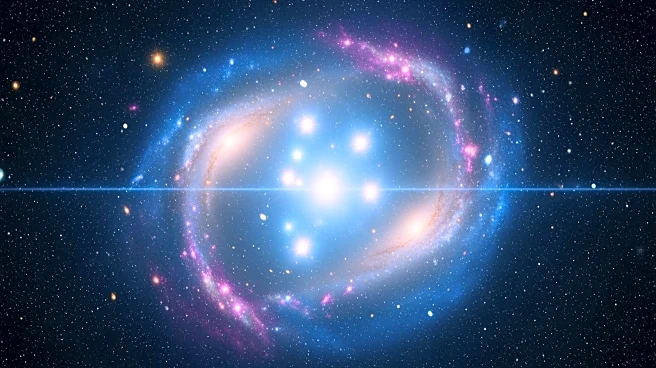
NASA's James Webb Space Telescope (JWST) has potentially identified some of the universe's first stars, known as Population III (Pop III) stars, in a galaxy called LAP1-B, located 13 billion light-years from Earth. These stars, formed shortly after the Big
Bang, are believed to be massive and emit intense ultraviolet light. The discovery was made possible through JWST's infrared data and gravitational lensing, which magnified the light from these stars. The findings suggest that these stars formed in a low-metallicity environment, primarily composed of hydrogen and helium, and could be the building blocks of larger galaxies.
Why It's Important?
The discovery of Pop III stars is significant as it provides a rare glimpse into the early universe and the formation of its first cosmic structures. Understanding these stars can offer insights into the evolution of galaxies and the role of dark matter in star formation. This research could reshape our understanding of the universe's history and the processes that led to the formation of galaxies. The findings also highlight the capabilities of the JWST in exploring distant cosmic phenomena, potentially leading to more groundbreaking discoveries in the field of astronomy.
What's Next?
Researchers plan to conduct more detailed hydrodynamical simulations to explore the transition from Pop III to Pop II stars, the second generation of stars in the universe. These simulations aim to verify if the predictions align with the observed spectrum of LAP1-B and similar galaxies. The ongoing study of these ancient stars could lead to further discoveries about the universe's early stages and the factors influencing star formation.