





What's Happening?
An investigation by AURORAH GeoSignal Intelligence, a Geneva-based private firm, suggests that Russian satellites are assisting the Iran-aligned Houthis in targeting Saudi Arabia's military and energy infrastructure. The investigation, which examined
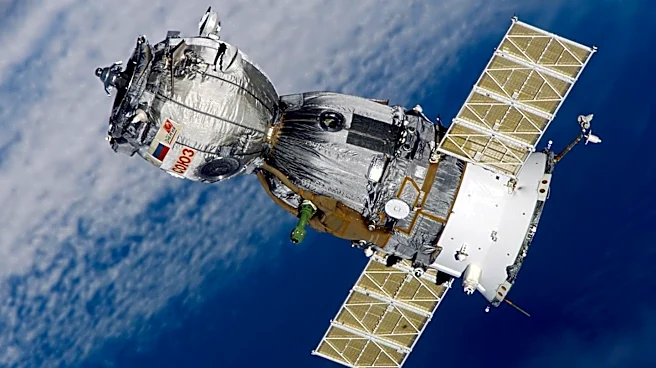
40 missile and drone attacks against Saudi Arabia by Houthis between July 1 and October 19, found a consistent pattern of Russian government and military satellites observing targeted areas before and after each attack. Nawaf Obaid, founder of AURORAH, stated that by reconstructing Russia's military reconnaissance architecture, his firm identified individual satellites, calculated their orbital trajectories, and correlated their activity with military developments. The identified satellites include Russia’s Bars-M military mapping satellites, Persona optical reconnaissance satellites, Lotos-S1 electronic intelligence satellites, Pion-NKS maritime reconnaissance systems, and Kondor-FKA radar-imaging satellites. This intelligence support is believed to have contributed to the Houthis' offensive along Yemen's western coast and their missile and drone targeting against Saudi Arabia, including precision strikes on critical oil pipeline pumping stations.
Why It's Important?
This alleged Russian satellite support to the Houthis signifies a significant shift in the Yemeni conflict, moving it beyond its domestic dimensions and intertwining it with broader regional and international dynamics. The involvement of a major global power like Russia, even indirectly, complicates efforts to de-escalate the conflict and achieve a lasting peace. For Saudi Arabia, this development poses a substantial national security challenge, as it indicates that the Houthis are benefiting from sophisticated intelligence capabilities that enhance their targeting precision and operational effectiveness. This external support could prolong the conflict, increase its intensity, and further destabilize the already volatile Middle East region. It also highlights the deepening technological and military ties between Russia and Iran, with implications for global power balances and the effectiveness of sanctions regimes. The findings suggest that Saudi Arabia, despite its advanced military capabilities and U.S. backing, faces a more complex adversary than previously understood.
What's Next?
The revelation of alleged Russian satellite support to the Houthis is likely to prompt increased scrutiny and potential diplomatic responses from the United States and its allies. Saudi Arabia may intensify its diplomatic efforts with Russia and China, as indicated by previous discussions, to address this intelligence sharing. The Houthis, bolstered by such advanced intelligence, may continue or even escalate their attacks on Saudi infrastructure, posing ongoing threats to global energy markets. This situation could also lead to a re-evaluation of military strategies by the Saudi-led coalition, potentially seeking more robust counter-intelligence measures or enhanced defensive capabilities. The deepening military cooperation between Russia and Iran, and its extension to proxy groups like the Houthis, suggests a more entrenched and complex geopolitical landscape in the region, making a swift resolution to the Yemeni conflict less likely. International bodies, such as the United Nations, may face renewed calls to address external interference in the conflict.
Beyond the Headlines
The alleged use of Russian satellites by the Houthis raises profound questions about the ethics of state-sponsored intelligence sharing in proxy conflicts and its impact on international law. If confirmed, it underscores how advanced technology, particularly satellite reconnaissance, can be weaponized to prolong and intensify conflicts, blurring the lines of direct engagement. This development also highlights the evolving nature of modern warfare, where non-state actors can leverage sophisticated state-level intelligence assets. Furthermore, it exposes the limitations of traditional military superiority when confronted with adversaries equipped with advanced targeting data. The situation could set a precedent for future conflicts, where access to space-based intelligence becomes a critical determinant of battlefield success, potentially leading to a new arms race in satellite technology and counter-satellite measures. This also challenges the notion of neutrality in space, as commercial and military satellite data can be repurposed for strategic advantage in terrestrial conflicts.