
What's Happening?
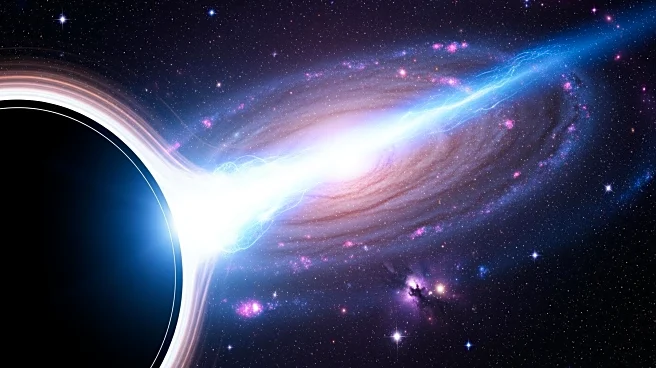
Researchers using the James Webb Space Telescope (JWST) have confirmed the existence of a Supersonic Runaway Supermassive Black Hole, named RBH-1, which was first detected in 2023. This black hole, located
7.8 billion light years away, is racing away from its host galaxy at a speed of 3.43 million km/h. It contains approximately 20 million solar masses and has left a 200,000-light-year-long trail of newborn stars in its wake, a distance twice the diameter of the Milky Way galaxy. The phenomenon is believed to have occurred due to a complex interaction involving the merger of two galaxies, followed by the introduction of a third galaxy. This led to a three-body interaction, resulting in the ejection of the lightest black hole with a significant velocity kick.
Why It's Important?
The discovery of RBH-1 provides significant insights into the dynamics of galaxy mergers and the behavior of supermassive black holes. Understanding such phenomena is crucial for astrophysics as it challenges existing models of galaxy formation and evolution. The ability of a black hole to leave its host galaxy and create a trail of stars highlights the complex gravitational interactions that can occur in the universe. This discovery could lead to a reevaluation of how galaxies evolve and the role of black holes in shaping the cosmic environment. It also underscores the capabilities of the JWST in observing distant cosmic events, potentially leading to more groundbreaking discoveries in the future.