




What's Happening?
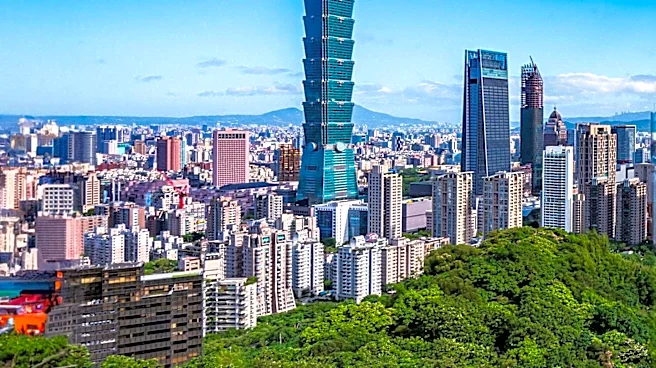
Taiwan is reportedly considering a more assertive sanctions strategy, moving beyond its current approach of primarily following international restrictions. Despite its advanced chip manufacturing industry, often called its 'silicon shield,' Taiwan has
been reluctant to fully utilize its economic strengths to constrain adversaries. This reluctance has allowed countries like China, Russia, and the Myanmar junta to act against Taiwan's interests and even use Taiwan as a means to evade sanctions imposed by other democracies. Taiwan has previously applied export controls to Chinese tech giants like Huawei and is now planning to introduce curbs on advanced chips to all customers in China, not just designated companies. However, Taiwanese officials remain hesitant to restrict exports in the semiconductor sector, which is crucial for its economic growth. The current political landscape in Taiwan, with the opposition Kuomintang (KMT) controlling the Legislative Yuan, presents a challenge, as the KMT generally supports closer economic integration with China, potentially obstructing efforts to build a stronger sanctions regime.
Why It's Important?
Taiwan's potential shift towards a more robust sanctions strategy holds significant implications for global technology supply chains, international relations, and U.S. foreign policy. Taiwan's dominance in advanced semiconductor manufacturing means that any restrictions on chip exports could have a profound impact on economies worldwide, including the U.S., which relies heavily on these components for various industries. By leveraging its 'silicon shield' more aggressively, Taiwan could gain considerable diplomatic and economic leverage against countries that undermine its interests, potentially altering the dynamics of its relationship with China and other authoritarian states. This move could also align Taiwan more closely with U.S. and European efforts to counter adversarial actions, strengthening democratic alliances. However, such a strategy also carries risks, including potential economic retaliation from China and internal political divisions within Taiwan, as the KMT's stance on economic integration with China could hinder legislative efforts to implement broader sanctions. The effectiveness of this strategy would depend on Taiwan's ability to navigate these complex internal and external pressures while maintaining its economic stability.
What's Next?
Taiwan's next steps will likely involve internal debates and legislative processes to determine the scope and implementation of a new sanctions strategy. The current political division in the Legislative Yuan, with the KMT's control, suggests that passing new legislation for a more ambitious sanctions regime could face significant obstruction. However, the source notes that the KMT has previously supported sanctions against Russia, indicating potential for bipartisan consensus on measures targeting third countries. Taiwan may explore a broader model for sanctions, moving beyond specific high-tech commodities to include restrictions on entire countries or industries that act against its interests. This could involve stricter measures to prevent the use of Taiwanese ports for transshipment of sanctioned goods and preventing sanctioned actors from using Taiwan to secure goods and services. The international community, particularly the U.S. and its allies, will closely monitor these developments, as Taiwan's actions could influence global efforts to counter economic coercion and protect critical supply chains. The balance between economic growth and national security will be a central consideration for Taiwanese policymakers.
Beyond the Headlines
Beyond the immediate policy implications, Taiwan's consideration of a new sanctions strategy reflects a deeper evolution in its approach to national security and international standing. For decades, Taiwan has navigated a complex geopolitical landscape, often relying on its economic prowess as a de facto form of soft power. The idea of actively 'wielding the silicon sword' signifies a potential shift towards a more assertive and instrumental use of its economic strengths. This move could redefine Taiwan's role on the global stage, transforming it from a recipient of international support into a more active participant in shaping global economic and security norms. Ethically, it raises questions about the responsibility of a major economic power to use its leverage for geopolitical ends, especially when its own sovereignty is at stake. Culturally, it could foster a stronger sense of national resilience and self-reliance within Taiwan, as it actively seeks to protect its interests through innovative means. The long-term impact could be a more robust and independent foreign policy for Taiwan, challenging the traditional narratives of its international isolation and demonstrating its capacity to influence global events.