
What's Happening?
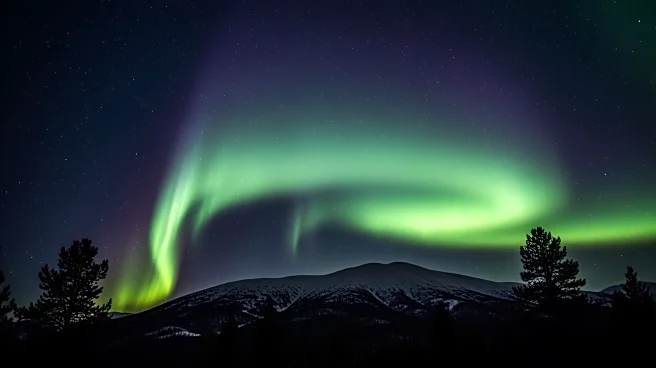
On December 18, 2025, NOAA has forecasted a G1 (minor) geomagnetic storm, which may allow for aurora viewing at high latitudes. This forecast coincides with a series of celestial events, including the
closest approach of the interstellar Comet 3I/ATLAS to Earth. The comet, which originated outside our solar system, is making its closest pass at approximately 167 million miles from Earth. Additionally, the Moon is in a waning crescent phase, setting up a pre-dawn scene with Mercury visible in the morning twilight. Jupiter and Saturn are also prominent in the night sky, with Jupiter rising in the east and Saturn setting in the west.
Why It's Important?
The potential for aurora viewing is significant for photographers and skywatchers in high-latitude regions such as Alaska and northern Canada. The geomagnetic storm, while minor, highlights the ongoing solar activity that can impact satellite operations and power grids. The appearance of Comet 3I/ATLAS is a rare astronomical event, offering scientists a chance to study an interstellar object and gain insights into the formation of planetary systems beyond our own. The alignment of celestial bodies provides an opportunity for educational outreach and public engagement in astronomy.
What's Next?
Skywatchers are advised to look for the aurora in high-latitude areas, although mid-latitude sightings are less likely. The Virtual Telescope Project is hosting a livestream of Comet 3I/ATLAS, allowing global audiences to witness the event. As the Moon approaches its new phase, the upcoming Ursid meteor shower will benefit from minimal moonlight, providing favorable conditions for meteor observation. These events encourage continued public interest in astronomy and may inspire future scientific research.