



What's Happening?
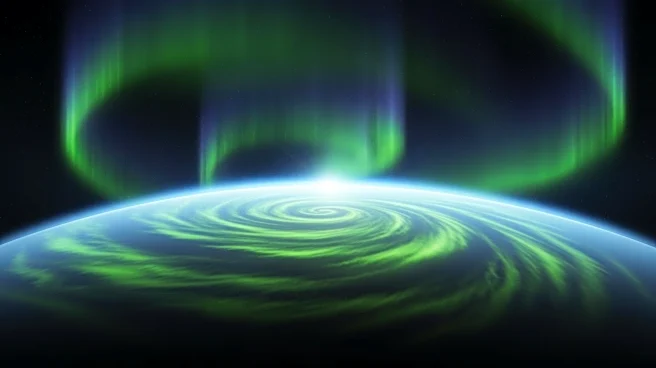
NASA's James Webb Space Telescope has provided a groundbreaking vertical view of Uranus's ionosphere, offering new insights into the planet's auroras and magnetic field. Released on February 19, 2026, the image reveals how Uranus's tilted magnetic field shapes
its auroras, providing the most detailed portrait yet of their formation. The data also shows how Uranus's atmosphere has continued to cool since the 1990s. Uranus's magnetosphere is unique in the Solar System, being tilted and offset from the planet's rotation axis, causing auroras to move in complex patterns. This research enhances understanding of ice-giant planets and aids in characterizing giant planets outside our Solar System.
Why It's Important?
The findings from the Webb Telescope are significant for planetary science, offering a deeper understanding of Uranus's atmospheric and magnetic properties. This research contributes to the broader field of exoplanet studies, as insights gained from Uranus can be applied to understanding similar ice giants beyond our Solar System. The ability to map Uranus's ionosphere and auroras with such precision marks a technological advancement in space observation, showcasing the capabilities of the James Webb Space Telescope. This knowledge could inform future missions and studies aimed at exploring the outer planets and their unique characteristics.