









What's Happening?
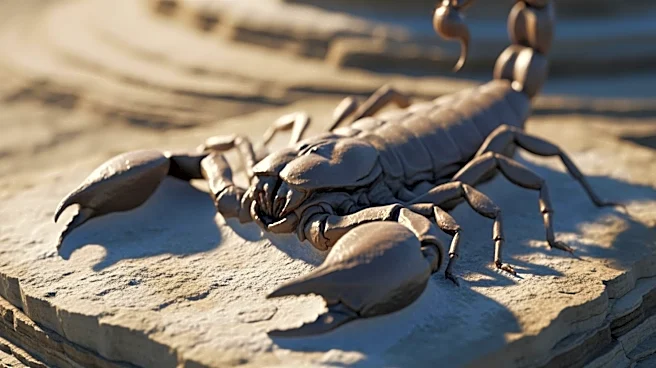
Researchers in the UK have confirmed the identity of Praearcturus gigas, potentially the largest known scorpion in history, measuring over a meter in length. This discovery follows an extensive fossil study using advanced imaging techniques. The scorpion lived
approximately 415 million years ago, during a time when life on land was just beginning to emerge. The study provides insights into early terrestrial ecosystems and the evolutionary history of arthropods. The findings suggest that Praearcturus gigas may have dominated its environment due to a lack of large predators, and it likely spent part of its life hunting in water.
Why It's Important?
The confirmation of Praearcturus gigas as the largest known scorpion offers valuable insights into the evolution of life on Earth, particularly during the Early Devonian period. Understanding the characteristics and behaviors of such ancient creatures helps scientists reconstruct past ecosystems and evolutionary pathways. This research contributes to the broader knowledge of how life transitioned from water to land, a pivotal moment in Earth's history. The study also highlights the importance of fossil analysis in uncovering the diversity and adaptability of ancient species, which can inform current biodiversity and conservation efforts.
Beyond the Headlines
The discovery of Praearcturus gigas raises intriguing questions about the evolutionary pressures that led to its size and ecological role. The scorpion's adaptation to both land and water environments suggests a complex evolutionary history, potentially involving multiple habitat transitions. This finding underscores the dynamic nature of ancient ecosystems and the adaptability of life forms in response to environmental changes. The study also emphasizes the role of advanced imaging techniques in paleontology, enabling more detailed and accurate reconstructions of extinct species and their habitats.