



What's Happening?
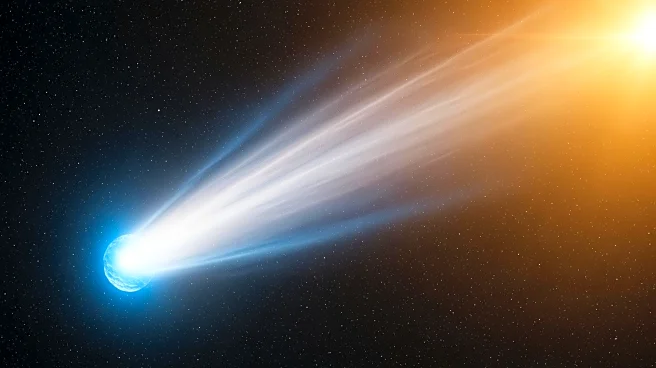
A newly discovered comet, named C/2026 A1, is currently making its way towards the sun. This celestial body was identified by a team of French scientists at the AMACS1 Observatory in Chile on January 13, 2026. According to NASA and Sky & Telescope, the comet is part
of the Kreutz family, known for their unusual orbits and close proximity to the sun. C/2026 A1 is approximately 1.5 miles wide and is expected to reach its closest point to the sun, known as perihelion, on April 4, 2026. At this point, it will be about 465,000 miles from the sun. The comet is anticipated to become visible to the naked eye, appearing as a bright object in the night sky, starting in mid-March, weather permitting.
Why It's Important?
The discovery of C/2026 A1 is significant as it adds to the understanding of the Kreutz family of comets, which have historically been associated with spectacular solar phenomena. The close approach of this comet to the sun presents an opportunity for scientists to study its behavior and composition under extreme solar conditions. This could provide insights into the early solar system and the processes that govern cometary dynamics. Additionally, the visibility of the comet to the naked eye offers a rare chance for the public to engage with astronomical events, potentially sparking interest in space science and exploration.
What's Next?
As C/2026 A1 approaches its perihelion, astronomers and observatories worldwide will closely monitor its trajectory and behavior. There is a possibility that the comet could disintegrate due to the intense heat and gravitational forces near the sun. If it survives, it will offer a spectacular display in the night sky. Observations will continue to refine predictions about its path and potential impacts on solar phenomena. Public interest is likely to grow as the comet becomes visible, leading to increased educational outreach and media coverage.