

What's Happening?
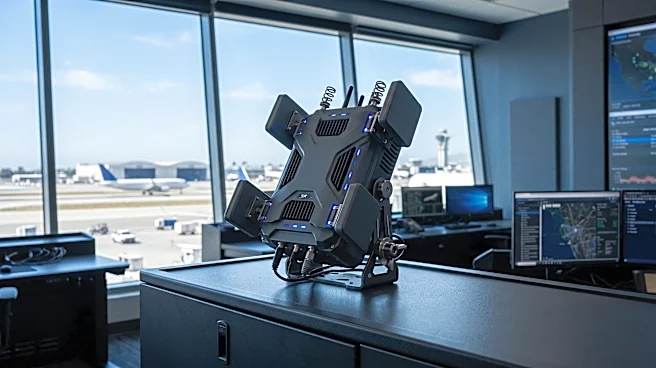
Senator Mike Lee (R-UT) has introduced the Guard the Skies Act, legislation aimed at authorizing National Guard units to counter threats from unmanned aerial systems (UAS), commonly known as drones. This bill would allow the National Guard to operate
under the direction and control of state governors to jam, intercept, or down drone threats. A companion bill has been introduced in the House by Representative Michael McCaul (R-TX). The current federal framework limits the National Guard's authority in this area, creating a gap in security capabilities. The proposed legislation seeks to address this by empowering local authorities with federal support to manage complex airspace threats, particularly around major events and critical infrastructure. The bill builds upon the FY26 National Defense Authorization Act's Safer Skies Act, which previously devolved some counter-UAS authority to state and local law enforcement.
Why It's Important?
The Guard the Skies Act is significant because it addresses a critical vulnerability in U.S. national security and public safety. The proliferation of drones presents evolving threats, from espionage and terrorism to disruption of major public gatherings. Current federal agencies with counter-UAS authority are reportedly stretched thin, and state and local law enforcement often lack the necessary resources and legal authorization to effectively neutralize these threats. By empowering the National Guard, the bill aims to create a more robust, localized defense mechanism. This could enhance security for large-scale events, such as the 2034 Winter Olympics in Salt Lake City, Utah, and protect critical infrastructure from potential drone-related incidents. The legislation also highlights a broader trend of devolving certain security responsibilities to state and local levels, recognizing the need for agile responses to localized threats.
What's Next?
The Guard the Skies Act has been introduced in both the Senate and the House, but it has not yet been enacted, and no committee action or scheduled vote has been indicated. Its progression through Congress will be a key indicator of how federal, state, and local authorities will divide responsibilities for drone security. If enacted, residents near major gatherings or critical infrastructure could anticipate increased airspace security measures. The bill's future will depend on congressional debate, potential amendments, and the political will to address the identified security gaps. Stakeholders, including state governors, federal security agencies, and event organizers, will closely monitor its development, as its passage could significantly alter the landscape of domestic drone threat mitigation.
Beyond the Headlines
The introduction of the Guard the Skies Act underscores the growing challenge posed by unmanned aerial systems and the evolving nature of domestic security. Beyond the immediate practical implications of countering drone threats, this legislation touches upon complex legal and ethical considerations regarding the use of force, surveillance, and the balance between federal and state powers. Authorizing the National Guard to intercept or down drones raises questions about potential collateral damage, privacy concerns, and the legal framework governing such actions. It also reflects a broader societal adaptation to technological advancements, where tools initially designed for civilian use can be weaponized or misused, necessitating new legislative and operational responses. The debate surrounding this bill could set precedents for how the U.S. addresses future technological threats that blur the lines between traditional warfare and domestic security.