


What's Happening?
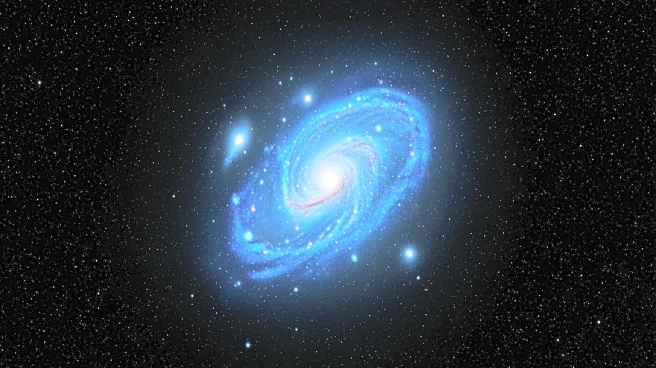
The NASA/ESA Hubble Space Telescope has captured a striking image of the blue dwarf galaxy Markarian 178 (Mrk 178), located 13 million light-years away in the constellation Ursa Major. This galaxy is part of a group of over 1,500 galaxies identified by
Armenian astrophysicist Benjamin Markarian, known for their brightness in ultraviolet light. Mrk 178 is characterized by its abundance of young, hot stars, which give it a predominantly blue appearance. However, a collection of rare massive Wolf–Rayet stars near the galaxy's edge adds a reddish hue. These stars are in a late stage of stellar evolution, shedding their atmospheres through powerful winds, which contribute to the galaxy's spectrum with strong emission lines of ionized hydrogen and oxygen.
Why It's Important?
The observation of Markarian 178 provides valuable insights into the life cycle of stars and the processes that trigger star formation in galaxies. The presence of Wolf–Rayet stars, which are precursors to black holes or neutron stars, indicates a recent burst of star formation. Understanding these processes is crucial for astronomers studying the evolution of galaxies and the conditions that lead to the formation of massive stars. The data from Hubble's observations can help refine models of galactic development and the role of intergalactic interactions in star formation.
What's Next?
Researchers are investigating the potential causes of the recent star formation burst in Mrk 178. Theories include a collision with a gas cloud or disturbances from the intergalactic medium as the galaxy moves through space. Further observations and studies are needed to confirm these hypotheses and to explore the dynamics of such interactions. Continued monitoring of Mrk 178 and similar galaxies will enhance our understanding of the mechanisms driving star formation and the evolution of galaxies in the universe.
Beyond the Headlines
The study of galaxies like Markarian 178 also contributes to our understanding of the universe's structure and the distribution of matter. The interactions that trigger star formation can influence the chemical composition and future development of galaxies. Additionally, the presence of Wolf–Rayet stars offers a glimpse into the final stages of massive star evolution, providing a natural laboratory for studying the processes leading to supernovae and the formation of compact objects like black holes.