






What's Happening?
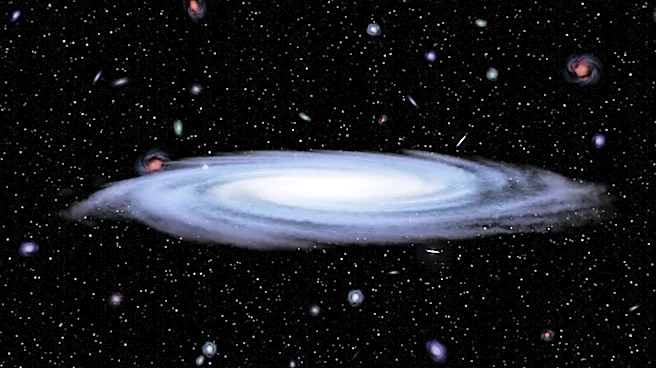
Recent research has revealed that cosmic structures connecting the universe are much larger than previously predicted, challenging the standard model of cosmology. This model, known as the Lambda cold dark matter (ΛCDM) model, suggests that the universe's
large-scale structure should appear uniform. However, new data indicates that galaxies cluster in preferred directions, forming anisotropies that persist over vast distances. This discovery, made by analyzing data from the Dark Energy Spectroscopic Instrument (DESI), suggests that the largest structures in the universe are significantly larger than expected, potentially signaling a need for a shift in modern cosmology.
Why It's Important?
The findings challenge a core tenet of cosmology, suggesting that the universe's structure is not as uniform as previously thought. This could have profound implications for our understanding of the universe and the fundamental laws that govern it. If these large-scale structures are confirmed, it may indicate a gap between current cosmological theories and observations, prompting a reevaluation of existing models. This could lead to new insights into the nature of dark matter, dark energy, and the forces shaping the universe.
What's Next?
DESI is expected to release new observations within a year, and additional data from the Euclid space telescope and the Vera C. Rubin Observatory will provide further insights. These observations will help scientists determine the true extent of these large-scale structures and their implications for cosmology. If future surveys continue to find coherent directional structures on even larger scales, it could lead to significant revisions in our understanding of the universe's formation and evolution.