







What's Happening?
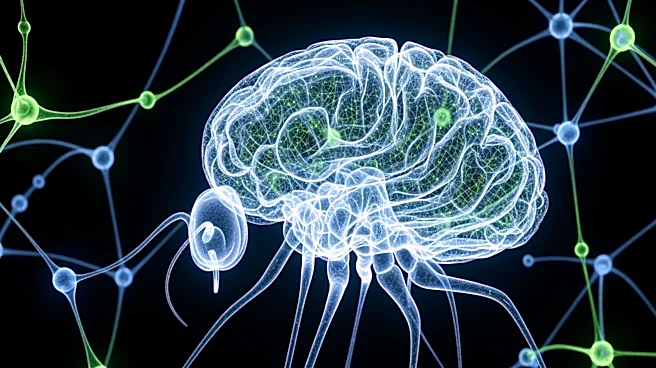
An international team led by Harvard Medical School and Princeton University has published a complete connectome of the fruit fly's central nervous system, now available as an open-source resource. This comprehensive wiring diagram maps all neural connections
in the fruit fly, Drosophila melanogaster, using electron microscopy and AI tools. The connectome provides insights into complex behaviors and motor control, revealing that motor functions are primarily managed by local neural circuits rather than centralized brain control. This resource aims to advance research into nervous system functions and behaviors.
Why It's Important?
The open-source release of the fruit fly connectome is a significant milestone in neuroscience, offering researchers a detailed model to study neural connections and behaviors. The fruit fly serves as an effective model organism due to its relatively simple nervous system and complex behaviors. This resource could lead to breakthroughs in understanding neural mechanisms and inform research on human nervous systems. By providing a detailed map of neural connections, the connectome may help identify fundamental principles of nervous system operation across species.
What's Next?
Researchers plan to enhance the connectome with additional data, such as neuropeptides, to further understand neuron communication. The connectome's availability is expected to facilitate new studies on neural function and behavior, potentially leading to applications in translational medicine. As the connectome is utilized in various research projects, it may contribute to the development of new therapies for neurological disorders and improve our understanding of brain-body interactions.