






What's Happening?
A new theoretical framework developed by researchers from Kyushu University, the University of Waterloo, and Stockholm University suggests that many scenarios previously thought to demonstrate a 'quantum superposition of gravity' can also be interpreted
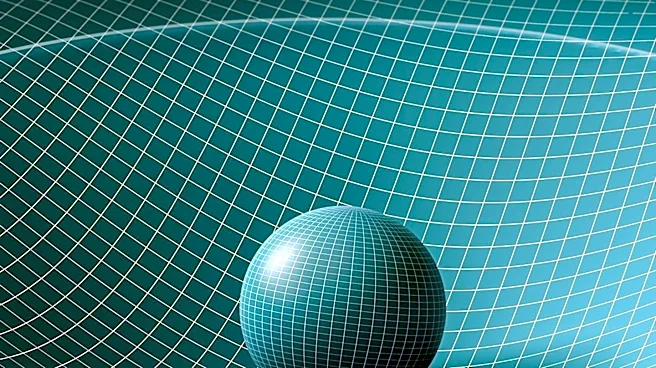
as quantum particles existing in ordinary gravitational fields. This study, published in npj Quantum Information, highlights the 'Relativity of Spacetime Superpositions,' where what appears to be quantum gravity can often be described using classical gravity and spacetime. The research aims to clarify the ambiguity in interpreting experiments that test gravity's quantum nature, providing a roadmap for future experimental designs.
Why It's Important?
The study addresses one of the most significant challenges in physics: unifying quantum mechanics and gravity into a single theory. Understanding whether gravity can be described by quantum mechanics is crucial for advancing fundamental physics. The findings could influence the design of future experiments, helping researchers identify which observations genuinely require a quantum description of gravity. This clarity is essential for progressing toward a unified theory, which could lead to technological advancements similar to those that arose from previous breakthroughs in quantum physics and Einstein's theory of gravity.
What's Next?
The research provides a framework for designing experiments that can distinguish between classical and quantum descriptions of gravity. Future experiments will need to focus on identifying signatures that genuinely require a quantum description of gravity. This work narrows the search for evidence of quantum gravity, guiding researchers in their quest to understand how gravity and quantum mechanics fit together. The study's implications could lead to new insights and technologies, as history has shown that exploring fundamental laws often results in unexpected advancements.