








What's Happening?
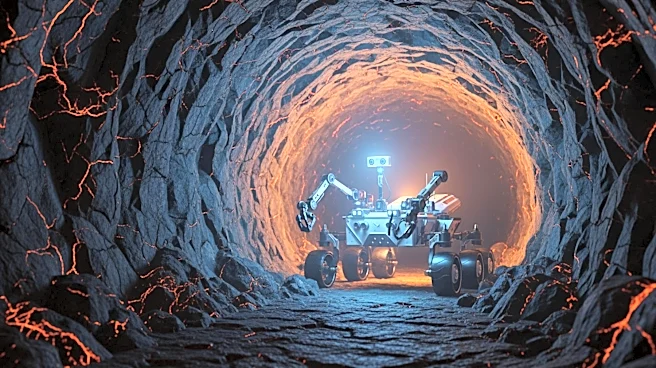
European robots have successfully explored a volcanic tunnel on the Spanish island of Lanzarote, a mission that could pave the way for future space bases on the Moon and Mars. The European Space Agency (ESA) led this initiative, deploying autonomous robots to navigate
and map the tunnel, simulating conditions on extraterrestrial terrains. These lava tunnels, formed by ancient volcanic activity, offer potential sites for human colonization due to their natural protection against harsh space environments. The mission demonstrated the robots' ability to operate independently, a crucial capability for future space exploration where real-time human control is not feasible.
Why It's Important?
This development is significant for space exploration, as it addresses the challenge of establishing human bases on the Moon and Mars. Lava tunnels provide natural shielding from radiation, extreme temperatures, and meteor impacts, making them ideal for habitation. The success of autonomous robots in navigating these environments marks a step forward in space technology, potentially accelerating the timeline for human colonization of other planets. This research not only advances scientific understanding but also has implications for international space policy and collaboration, as countries and agencies work together to explore and utilize extraterrestrial resources.