








What's Happening?
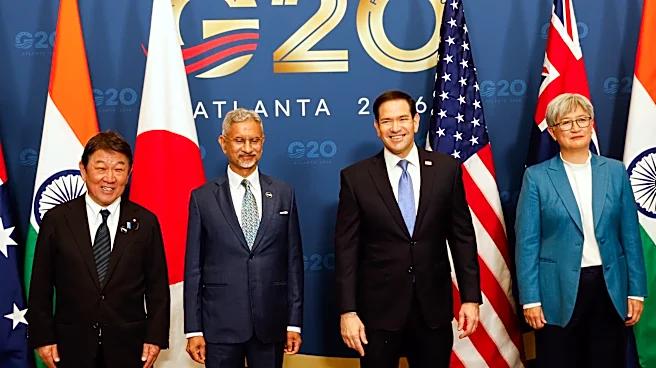
The Quad countries—India, Australia, Japan, and the U.S.—have announced their intention to provide over $85 million in technical and financial assistance to promote access to trusted artificial intelligence (AI) across the Indo-Pacific. This commitment
was made during a meeting of the foreign ministers and the U.S. Secretary of State in Atlanta, Georgia. The ministers reaffirmed their dedication to a free and open Indo-Pacific and reviewed progress on ongoing Quad initiatives. Key areas of cooperation include economic security, critical minerals, maritime surveillance, and emerging technologies. They emphasized the importance of reliable global supply chains and resilient infrastructure, expressing concern over economic coercion, arbitrary export restrictions, and non-market policies. The Quad also highlighted the strategic importance of international maritime routes, stressing the need to protect navigational rights in critical straits like the Strait of Hormuz and the Red Sea. Initiatives such as the Quad AI Accelerator and the Quad Critical Minerals Initiative Framework are central to these efforts, focusing on recovering valuable minerals from electronic waste and strengthening supply chain resilience.
Why It's Important?
This pledge of over $85 million for AI assistance and broader cooperation is critical for strengthening the Indo-Pacific region's technological capabilities and economic resilience. By promoting access to trusted AI, the Quad aims to foster economic growth and innovation while mitigating risks associated with emerging technologies. The focus on economic security and resilient supply chains, particularly for critical minerals, directly addresses vulnerabilities exposed by global disruptions and geopolitical tensions. Reducing dependence on single suppliers and establishing trusted recycling value chains for critical minerals is vital for the U.S. and its allies to secure essential resources for advanced technologies. Furthermore, the emphasis on maritime security and protecting navigational rights in international waters is crucial for global trade and energy security, directly impacting U.S. economic interests and strategic alliances. The Quad's efforts to counter economic coercion and non-market practices are significant for maintaining a level playing field in international commerce and protecting the interests of democratic economies.
What's Next?
The Quad countries will continue to implement initiatives such as the Quad AI Accelerator and the Quad Critical Minerals Initiative Framework. The U.S. has committed $10 million to support infrastructure in India and ASEAN countries for critical mineral recovery. Future efforts will include streamlining export and import procedures for recyclable materials. The first-ever Quad Business Leaders’ Forum will bring together industry leaders and government representatives to promote commercial deals in key sectors. Quad export credit agencies will meet in Tokyo on November 18 to identify cooperation opportunities. Digital connectivity and maritime security will remain prominent, with ongoing work on trusted undersea cable routes and best practices for securing critical digital infrastructure. The second Quad-at-Sea Ship Observer mission has already been conducted, and the first exercise under the Indo-Pacific Maritime Surveillance Collaboration initiative is planned for Sea Dragon 2027. The first Quad Maritime Domain Awareness Track 1.5 Symposium is scheduled for early 2027. The Quad will also identify priority countries for cooperation in advanced communication technologies like 5G, 6G, and Open RAN, and launch efforts to identify supply chain bottlenecks for semiconductors and AI hardware.
Beyond the Headlines
The Quad's initiatives extend beyond immediate economic and security concerns, touching upon deeper geopolitical and technological shifts. The focus on trusted AI and secure supply chains reflects a broader strategy to counter the influence of non-democratic states in critical technological domains. By investing in AI infrastructure and critical mineral recovery, the Quad aims to establish alternative, resilient ecosystems that align with democratic values and open market principles. This also has implications for global standards and norms in emerging technologies, potentially shaping the future of AI governance and supply chain management. The emphasis on maritime security in key international waterways underscores the ongoing competition for influence and control over global trade routes, highlighting the strategic importance of the Indo-Pacific. The collaboration also fosters a sense of shared responsibility among member nations, strengthening alliances and promoting a collective approach to regional challenges, which could lead to a more stable and prosperous Indo-Pacific region in the long term.