
What's Happening?
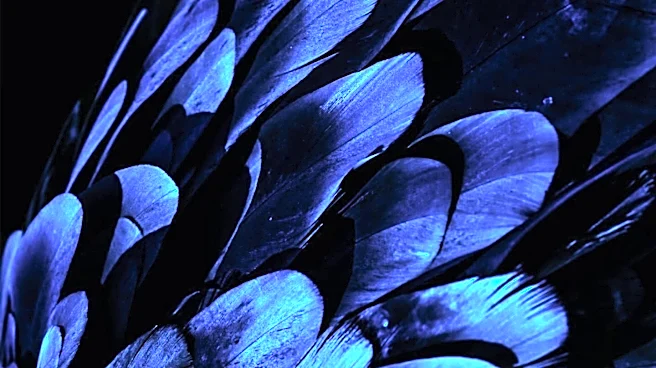
Researchers at Sun Yat-sen University have developed a new framework to understand how bird feathers evolved to control heat through near-infrared (NIR) reflectance. Published in the Proceedings of the Royal
Society B, the study examines how feathers reflecting NIR radiation help birds regulate body temperature in various climates. The research involved measuring visible and NIR reflectance from 1,980 bird specimens across 439 species. The findings suggest that visible reflectance can predict NIR properties, although the relationship varies among bird groups. This study provides insights into how birds adapt to different thermal environments and could improve biophysical models predicting bird responses to climate change.
Why It's Important?
Understanding how birds evolved heat-controlling feathers is crucial for predicting their adaptability to climate change. The study's framework could help fill gaps in existing reflectance datasets, aiding in the development of accurate models to estimate bird body temperature and heat stress. This research highlights the role of NIR reflectance in bird survival and adaptation, offering a new perspective on avian evolution. The findings could inform conservation strategies, particularly for species in rapidly changing environments.
What's Next?
Future research will aim to expand the dataset, particularly for tropical birds and those with complex coloration. The researchers plan to connect optical measurements with bird physiology to better understand how NIR reflectance affects temperature regulation and water loss. Hyperspectral imaging and artificial intelligence may be used to enhance reflectance data, improving predictions of how birds will cope with climate warming.