
What's Happening?
Researchers have uncovered a novel mechanism by which bacteria navigate through spaces barely larger than themselves. The study, conducted by a team led by Dr. Daisuke Nakane and Dr. Tetsuo Kan at the University
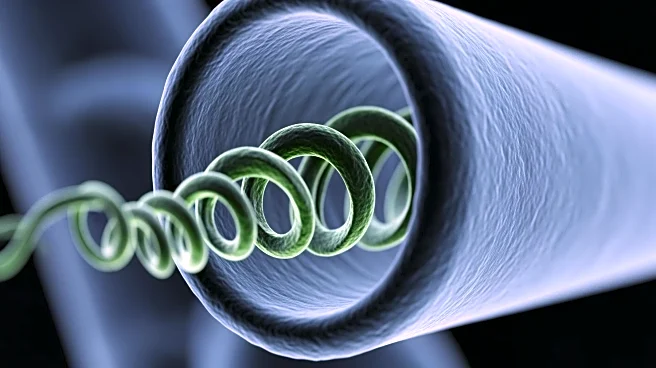
of Electro-Communications, along with Dr. Hirofumi Wada at Ritsumeikan University and Dr. Yoshitomo Kikuchi at the National Institute of Advanced Industrial Science and Technology, reveals that certain bacteria use a 'flagellar wrapping' motion to move through 1-micrometer-wide tunnels. This motion involves the bacteria wrapping their flagella around their bodies, allowing them to propel forward in confined spaces. The research utilized a microfluidic device mimicking insect gut channels to observe this behavior. The study highlights the role of a flexible joint in the flagellum, known as the hook, which is crucial for this movement. The findings were published in Nature Communications.
Why It's Important?
This discovery is significant as it reveals a new survival strategy among bacteria, showcasing how microorganisms can exploit mechanical principles to navigate complex environments. Understanding this micro-scale drilling motion could inspire the development of microrobots capable of moving through viscous or crowded environments, such as tissues or filtration systems. The research provides insights into the mechanical ingenuity evolved by nature, which could have applications in various fields, including biotechnology and engineering. The ability of bacteria to move through confined spaces by flagellar wrapping could lead to advancements in designing devices that mimic these natural processes.
What's Next?
Future research may focus on further exploring the applications of this discovery in engineering and biotechnology. The development of microrobots inspired by bacterial flagellar wrapping could revolutionize how we approach challenges in medical and industrial fields. Additionally, understanding the genetic and mechanical aspects of this bacterial movement could lead to new strategies for controlling bacterial infections, particularly those involving symbiotic relationships with hosts. Researchers may also investigate other microorganisms to see if similar mechanisms are employed, potentially broadening the scope of this discovery.
Beyond the Headlines
The implications of this research extend beyond immediate applications, as it challenges our understanding of microbial behavior and adaptation. The study highlights the elegance of natural solutions to mechanical problems, offering a new perspective on how life forms have evolved to overcome environmental challenges. This could lead to a deeper appreciation of the complexity and ingenuity of biological systems, influencing future research in microbiology and bioengineering.