



What's Happening?
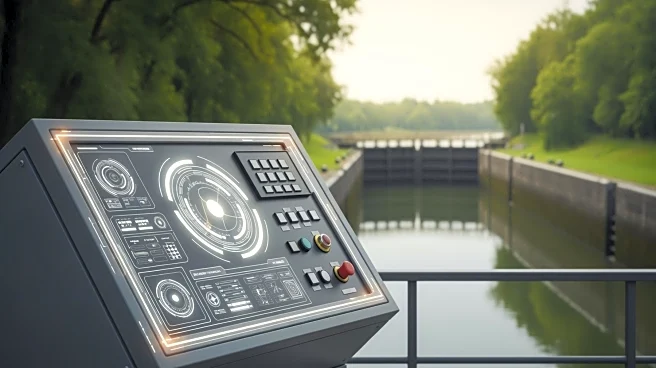
The Environment Agency has initiated a £2 million renovation project on the Bedford Lock, located on the River Great Ouse. This project, which began in October, is set to conclude by March 2026. For the first time, the agency is utilizing advanced technologies,
including Artificial Intelligence (AI) and high-resolution underwater cameras, to assess and repair the lock. Project manager Steven Wilby highlighted the use of these technologies to create 3D models of the lock's condition, which informed subsequent repair decisions. The lock, originally built in 1868 and last refurbished in the 1950s, required repairs due to damage from tree roots. The renovation includes fitting new doors and refurbishing the guillotine gate. The project aims to set a precedent for future lock renovations, making them more efficient and cost-effective.
Why It's Important?
The integration of AI and new technologies in infrastructure projects like the Bedford Lock renovation represents a significant advancement in civil engineering and environmental management. By employing AI, the Environment Agency can improve the accuracy and efficiency of assessments, potentially reducing costs and enhancing safety. This approach could serve as a model for future projects, encouraging other agencies to adopt similar technologies. The successful implementation of AI in this project may lead to broader acceptance and utilization of AI in public infrastructure, impacting how such projects are planned and executed across the U.S. and internationally.
What's Next?
The completion of the Bedford Lock renovation is scheduled for March 2026, with ongoing monitoring to ensure the effectiveness of the new technologies. The Environment Agency plans to evaluate the outcomes and consider applying these methods to other locks and infrastructure projects. This could lead to a shift in standard practices, with AI becoming a staple in environmental and civil engineering projects. Stakeholders, including government agencies and contractors, may explore further innovations to enhance project efficiency and sustainability.
Beyond the Headlines
The use of AI in infrastructure projects raises questions about the future role of technology in environmental management. Ethical considerations regarding AI's decision-making capabilities and its impact on employment in traditional engineering roles may arise. Additionally, the success of this project could influence policy decisions, encouraging investment in technological advancements for public works. Long-term, this could lead to a transformation in how infrastructure is maintained, with AI playing a central role in ensuring sustainability and resilience.