



What's Happening?
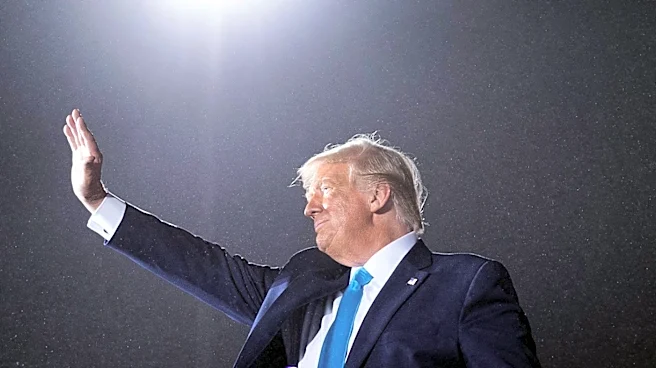
President Trump publicly admonished CNN reporter Kristen Holmes during a meeting in the Oval Office on Monday, August 17, 2026. The incident occurred after Holmes questioned President Trump about whether North Korean leader Kim Jong-un had requested the reduction
in joint military exercises between the U.S. and South Korea. President Trump told Holmes to 'be quiet,' accusing her of being 'very disrespectful' in front of a young lifeguard present at the event. He then asked which news organization she represented, and upon learning it was CNN, he dismissed the network as 'fake news.' The White House later criticized Holmes on its rapid response X profile, accusing her of asking a 'repugnant and inhumane question' and suggesting her children would be 'disgusted and ashamed.' CNN defended Holmes, calling her a 'respected and talented journalist' who asked a 'difficult, relevant, and newsworthy question.'
Why It's Important?
This incident underscores the ongoing contentious relationship between President Trump and certain media outlets, particularly CNN, and raises significant concerns about press freedom and the treatment of journalists in the White House. President Trump's direct verbal attack and the White House's subsequent social media post represent a continued pattern of undermining the credibility of news organizations and personally attacking reporters. This behavior can have a chilling effect on journalism, potentially discouraging critical questioning and fostering an environment where factual reporting is dismissed as 'fake news.' For the U.S. public, it contributes to a polarized media landscape and makes it more challenging to discern objective information. The incident also highlights the broader debate about the role of the press in holding power accountable and the boundaries of presidential conduct in interactions with the media.
What's Next?
The confrontation is likely to intensify the existing tensions between President Trump's administration and CNN, potentially leading to further restrictions on access for certain journalists or increased verbal attacks. Media organizations and press freedom advocates are expected to continue to condemn such behavior, emphasizing the importance of a free and independent press in a democratic society. The incident may also fuel public debate about media bias and the responsibilities of both politicians and journalists. Depending on the political climate, this type of interaction could become a recurring feature of presidential press engagements, further entrenching divisions between the administration and parts of the media. The long-term impact could be a further erosion of public trust in both political institutions and the media, making it harder for citizens to engage with informed discourse.
Beyond the Headlines
The exchange between President Trump and the CNN reporter reflects a deeper societal struggle over truth, authority, and the role of information in the digital age. President Trump's consistent labeling of critical news as 'fake news' is not merely a rhetorical tactic but a strategy to delegitimize institutions that challenge his narrative. This approach can have profound implications for democratic processes, as it undermines the public's ability to make informed decisions based on verifiable facts. The White House's personal attack on Holmes, extending to her family, crosses a line that many consider unacceptable in political discourse, potentially normalizing aggressive tactics against perceived opponents. This trend could lead to a more hostile environment for journalists, both domestically and internationally, and may encourage authoritarian regimes to suppress independent media. The incident also raises questions about the ethical responsibilities of social media platforms in hosting and amplifying such attacks.