







What's Happening?
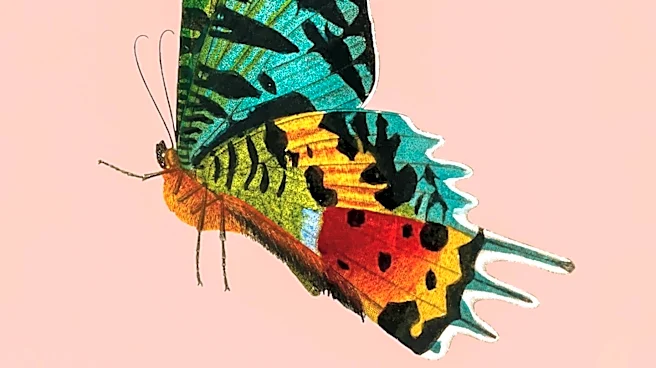
Andrei Sourakov, collection coordinator of Lepidoptera at the Florida Museum of Natural History and affiliate associate professor of entomology at the University of Florida, has successfully altered the shape of moth wings in a laboratory setting. This
seven-year study, published in the journal *Evolution & Development*, involved hand-rearing over 700 luna and polyphemus moths. By applying small quantities of sulfated polysaccharides, heparin and dextran sulfate, at precise moments during the moths' pupation stage, Sourakov induced significant changes in both wing patterns and the three-dimensional shape of the wings. This marks the first time wing shape has been experimentally manipulated in Lepidoptera, the order that includes moths and butterflies.
Why It's Important?
This groundbreaking research challenges previous assumptions about the fixed nature of wing shape in Lepidoptera and provides new insights into the mechanisms of insect development and evolution. The ability to manipulate wing shape experimentally opens new avenues for understanding how complex biological structures are formed and how they can adapt to environmental pressures. This discovery has implications for evolutionary biology, potentially explaining how species can rapidly change their appearance to evade predators or attract mates. It also suggests that seemingly complex evolutionary changes might arise from simple chemical cues, offering a more nuanced understanding of developmental plasticity and its role in adaptation.
What's Next?
The study's findings suggest that the same compounds and developmental pathways that influence wing patterns can also affect wing shape, depending on the timing of application. Future research will likely focus on further elucidating the precise molecular mechanisms by which heparin and dextran sulfate influence wing development. Scientists may also investigate whether similar manipulations are possible in other insect species or if these findings can be applied to understand developmental processes in other organisms. The study's implications for understanding evolutionary adaptation could lead to new models for predicting how species might respond to rapid environmental changes, such as those driven by climate change.
Beyond the Headlines
This research delves into the fundamental question of how biological forms arise and change, touching upon the 'cookie-cutter' idea of growth in Lepidoptera, where programmed cell death shapes the wings. The discovery that a simple chemical cue can dramatically alter wing morphology highlights the profound influence of developmental processes on evolutionary trajectories. It also raises ethical considerations regarding the potential for manipulating biological traits in other organisms. More broadly, the study underscores the intricate beauty and complexity of the natural world, revealing how subtle shifts at critical developmental stages can lead to significant phenotypic variations, offering a deeper appreciation for the elegance of biological design.