





What's Happening?
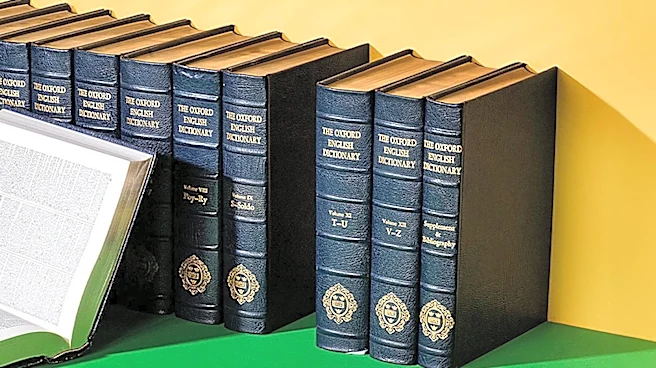
The Oxford English Dictionary (OED) has launched an AI Quotations Finder, a new tool designed to assist researchers in finding additional usage evidence for specific OED senses. This tool does not generate AI-created quotations but rather retrieves historical
examples of words from a source corpus, specifically EarlyPrint 1473-1800. It works by searching for a headword in the corpus, returning a thousand concordance lines, and then using AI to identify which of these examples match a particular OED sense. The AI further assesses the ten most relevant concordances to present 'candidate quotations.' This process typically takes around 50 seconds. The OED emphasizes that these candidate quotations are verbatim from the source corpus and are not AI-generated or hallucinated. While OED editors were involved in the tool's design and testing, the candidate quotations and their bibliographic metadata have not been verified by them and may not always accurately reflect the OED definition.
Why It's Important?
This development is significant for linguistic research and scholarship, particularly in the U.S. and globally, as it provides an advanced method for exploring the historical usage of words. By supplementing the existing OED quotations, the AI Quotations Finder offers a broader range of examples, potentially uncovering nuances and historical contexts that might otherwise be overlooked. This can benefit academics, etymologists, and writers by offering deeper insights into word evolution and usage. However, the caveat that candidate quotations are unverified by OED editors means researchers must exercise caution and cross-reference findings, highlighting the ongoing balance between technological advancement and human editorial oversight in academic resources. The tool's current limitation to senses where automated Word Sense Disambiguation works reliably also indicates its evolving nature and the challenges in applying AI to complex linguistic data.
What's Next?
The OED plans to continuously improve the AI Quotations Finder. Future developments include increasing the number of texts available for search and expanding the range of senses covered by the tool. Users are encouraged to provide feedback on errors or potential antedating quotations through the tool's feedback button, which will contribute to its refinement. As the tool evolves, it is expected to become more comprehensive and reliable, further integrating AI into linguistic research methodologies. The OED also clarifies that the full text containing candidate quotations is available on the EarlyPrint website, allowing researchers to access the original context. This ongoing development suggests a future where AI tools play an increasingly supportive role in academic research, while still requiring critical evaluation from human scholars.
Beyond the Headlines
The introduction of the AI Quotations Finder by the OED raises broader questions about the role of artificial intelligence in academic and historical research. While the tool offers unprecedented speed and access to vast amounts of data, the explicit disclaimer regarding the unverified nature of the candidate quotations underscores the ethical and methodological considerations of integrating AI into scholarly work. It highlights the distinction between AI as a powerful search and categorization engine and the human expertise required for verification, interpretation, and contextualization. This initiative could pave the way for similar AI-powered tools in other humanities disciplines, potentially transforming how researchers interact with historical texts and data. It also emphasizes the importance of digital literacy and critical thinking skills for users of such tools, as the responsibility for accuracy ultimately remains with the researcher.