







What's Happening?
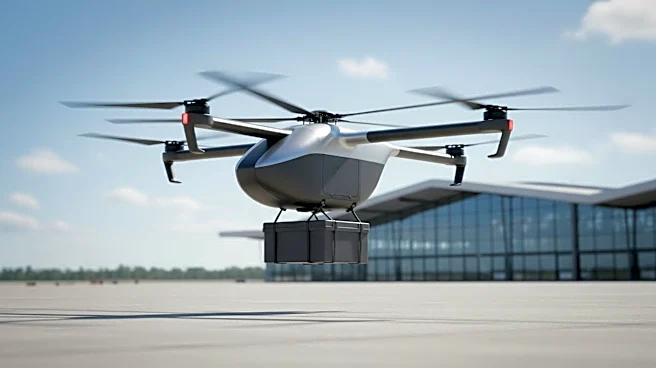
The Defense Advanced Research Projects Agency (DARPA) recently concluded its Lift Challenge, an initiative aimed at advancing vertical lift capabilities in small unmanned aerial systems. While no participant fully achieved the ambitious goal of creating
a drone capable of lifting four times its own weight, significant progress was made. AVIDrone Inc., a Canadian company with U.S. headquarters in Maryland, secured first place and $1.25 million for its electric helicopter design. Their Katana heavy-lift drone, weighing 29.3 pounds, demonstrated an unprecedented payload-to-weight ratio of 3.84 to 1, successfully lifting 112.4 pounds across approximately five nautical miles. The challenge sought to overcome the 'heavy-lift bottleneck' where multirotor drones typically carry payloads equal to or less than their own weight. Phillip 'Donna' Smith, the Lift Challenge program manager, highlighted the potential for this technology to revolutionize various industries. Other top performers included Massachusetts-based MTech Operations, which won $750,000 for a 3.64 to 1 ratio, and California-based Xtreme Aerial Concepts, awarded $500,000 for a 3.45 to 1 ratio. DARPA also recognized teams for subjective categories, such as the University of Maryland for Most Revolutionary Aerodynamic Design.
Why It's Important?
The advancements made in the DARPA Lift Challenge hold substantial importance for U.S. defense, commercial sectors, and broader economic development. The ability of small unmanned aerial systems to carry significantly heavier payloads than their own weight could transform logistics, agriculture, and construction industries by enabling more efficient and cost-effective transportation of goods and materials. For the defense sector, this technology could enhance tactical resupply operations, reconnaissance, and other critical missions in challenging environments. The prize money and recognition provided by DARPA incentivize innovation and accelerate the development of cutting-edge drone capabilities, fostering a competitive environment among U.S. and international companies with U.S. operations. The challenge also serves as a platform for networking and collaboration, potentially leading to the formation of new partnerships and the creation of next-generation aircraft. This push for heavy-lift drone technology addresses a critical limitation in current drone capabilities, opening doors for new applications and market opportunities.
What's Next?
Following the DARPA Lift Challenge, the focus will likely shift towards further refining and commercializing the technologies developed by participants like AVIDrone. The networking opportunities fostered by the challenge are expected to lead to collaborations among inventors, investors, and users, aiming to solve specific problems across various organizations in the U.S. and globally. Companies that demonstrated promising technologies, such as DefendTex with its high ratio but unscored run, may receive further investment and development to bring their innovations to fruition. The insights gained from the challenge will inform future research and development efforts in vertical lift technology, potentially leading to new DARPA initiatives or private sector investments. The goal is to transition these advanced drone capabilities from experimental stages to real-world applications, impacting industries like agriculture, logistics, and construction, and enhancing defense capabilities.
Beyond the Headlines
The DARPA Lift Challenge underscores a broader strategic imperative for the U.S. to maintain a technological edge in unmanned systems. The 'heavy-lift bottleneck' identified by DARPA highlights a critical area where innovation can yield significant economic and strategic advantages. Beyond the immediate applications, the development of highly efficient heavy-lift drones could have profound implications for supply chain resilience, disaster response, and infrastructure development. Ethically, as drone capabilities expand, discussions around their deployment, safety, and regulatory frameworks will become increasingly important. The challenge also reflects a model of government-funded innovation that leverages competition to accelerate technological breakthroughs, demonstrating how public sector initiatives can catalyze private sector advancements. The long-term shift could see drones becoming an integral part of everyday logistics, reducing reliance on traditional transportation methods and potentially lowering carbon footprints in certain sectors.