



What's Happening?
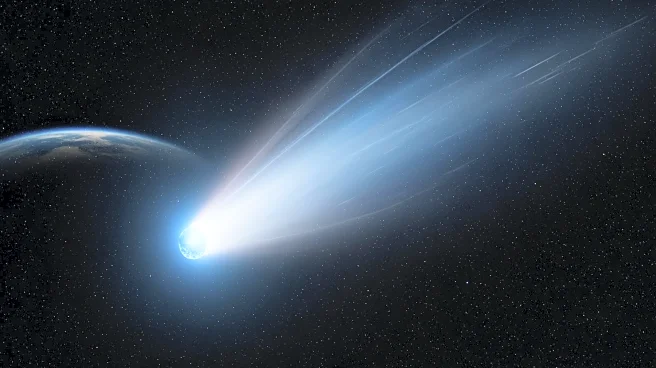
On December 19, 2025, Comet 3I/ATLAS, an interstellar object, made its closest approach to Earth, passing at a distance of approximately 168 million miles. This event marks the third time an interstellar object has been observed in our Solar System, following
1I/‘Oumuamua and 2I/Borisov. The comet's trajectory and characteristics have been closely monitored by NASA and ESA, with significant data being collected by various missions, including NASA's Europa Clipper, which provided a rare ultraviolet perspective. The comet is currently visible in the constellation Leo, although it requires a telescope for observation. The Virtual Telescope Project has scheduled a livestream to provide public viewing opportunities.
Why It's Important?
The observation of Comet 3I/ATLAS is significant as it provides a rare opportunity to study an interstellar object, offering insights into the composition and behavior of comets from outside our Solar System. This event allows scientists to gather data that could enhance our understanding of the formation and evolution of celestial bodies. The involvement of multiple space agencies and the use of advanced technology underscore the collaborative efforts in space exploration and the importance of international cooperation in scientific research. The data collected could have implications for future space missions and our understanding of the universe.
What's Next?
Following its closest approach, Comet 3I/ATLAS will continue its journey through the Solar System, with its next significant encounter being with Jupiter in March 2026. Observatories and space missions will continue to collect data as the comet moves away, gradually fading from view. The information gathered will be analyzed to refine models of interstellar objects and their trajectories. The scientific community will likely publish findings that could influence future research and exploration strategies.
Beyond the Headlines
The study of interstellar comets like 3I/ATLAS could lead to breakthroughs in understanding the origins of our Solar System and the potential for life elsewhere in the universe. These objects act as time capsules, preserving the conditions of their formation environments. The ethical and philosophical implications of discovering materials from other star systems could challenge our perceptions of life and our place in the cosmos.