



What's Happening?
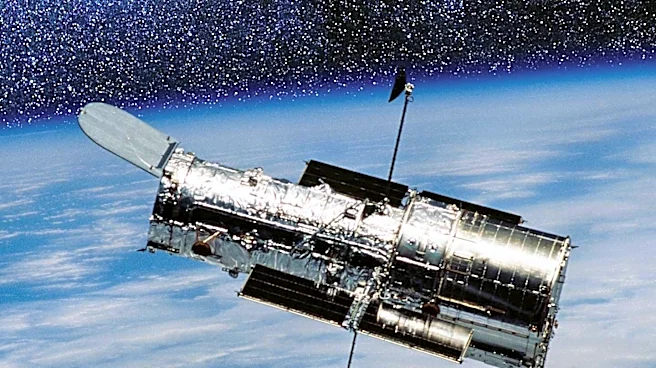
NASA's Hubble and James Webb Space Telescopes have jointly observed the Cat's Head Nebula, a star-forming region located approximately 7,500 light-years from Earth within the vast Carina Nebula. This specific area, nicknamed for its resemblance to a cat,
is providing astronomers with crucial insights into the complex process of star formation. Hubble's visible-light view reveals an opaque, dark brown pillar of dust, with a glowing red 'eye' that may indicate a young star partially embedded in dust. The surrounding diffuse material glows in various colors, indicating a mix of excited gas, dust, and stellar illumination. Webb's near-infrared images show detailed structures within the pillar and numerous stars, including background galaxies, while its mid-infrared view highlights intricate structures traced by warm dust and carbon-based molecules. These complementary observations are helping scientists understand how intense ultraviolet radiation and stellar winds from massive stars sculpt nebulae and drive photoevaporation, a process where gas is illuminated and ionized.
Why It's Important?
The combined observations from the Hubble and Webb telescopes are significant for advancing our understanding of star formation, a fundamental process in the universe. By providing both visible and infrared perspectives, the telescopes offer a more complete picture of the Cat's Head Nebula, revealing details that would be invisible to either telescope alone. This research helps astronomers decipher the elusive and chaotic mechanisms by which stars are born from gas and dust clouds. Understanding these processes is crucial for comprehending the evolution of galaxies, including our own Milky Way, and the conditions necessary for planetary system formation. The ability to pierce through dust with infrared light allows Webb to reveal hidden stars and structures, while Hubble's visible light provides context on the nebula's overall shape and composition. This collaborative approach sets a precedent for future astronomical studies, maximizing the scientific return from advanced space observatories.
What's Next?
Astronomers will continue to analyze the extensive data collected from the Cat's Head Nebula by both Hubble and Webb. This ongoing analysis is expected to yield further insights into the specific stages of star formation, the interaction between young stars and their surrounding environments, and the long-term evolution of nebulae. The findings from this study will likely inform future observational campaigns and theoretical models of star formation. The collaboration between these two powerful telescopes also serves as a model for future astronomical endeavors, potentially leading to more coordinated observations of other complex cosmic phenomena. The data may also contribute to a broader understanding of the Carina Nebula, a region known for its active star birth, and help refine our knowledge of stellar feedback mechanisms that shape galactic environments.
Beyond the Headlines
The study of the Cat's Head Nebula transcends immediate scientific findings by offering a glimpse into the dynamic and ever-changing nature of the cosmos. The nebula's temporary existence, destined to disperse as stars evolve, underscores the transient beauty and constant transformation occurring in space. This research also highlights the power of technological synergy, where different instruments, like Hubble and Webb, provide unique yet complementary data, leading to a more holistic understanding of complex phenomena. Ethically, such discoveries reinforce humanity's continuous quest for knowledge about our origins and place in the universe, inspiring future generations of scientists and fostering a deeper appreciation for cosmic processes. The intricate interplay of light, dust, and gas in star-forming regions also offers a profound aesthetic dimension, connecting scientific inquiry with artistic wonder.