
What's Happening?
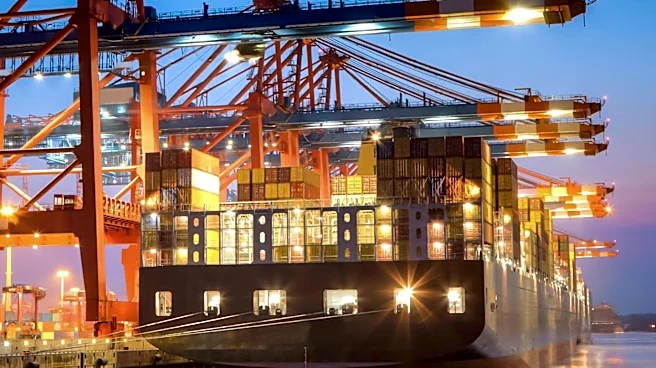
China has significantly invested in the Port of Chancay in Peru, with a $1.3 billion to $3.6 billion renovation project. This investment is led by the Chinese shipping giant COSCO, which owns 60% of the port,
while the remaining 40% is owned by the Peruvian mining company Volcan. The port, located about 50 miles north of Lima, has been upgraded to accommodate the world's largest container ships and incorporates advanced AI technologies. This development is part of China's broader strategy to enhance its trade routes and reduce shipping times between South America and Asia by up to 10 days. The Port of Chancay serves as a direct link between these regions, offering a shorter route compared to traditional shipping paths from the Gulf of Mexico.
Why It's Important?
The investment in the Port of Chancay is a strategic move by China to strengthen its trade infrastructure and reduce dependency on U.S. agricultural exports. By enhancing its shipping capabilities in South America, China aims to secure a more reliable and efficient supply chain for essential commodities like soybeans, corn, and sugar. This development could potentially shift trade dynamics, as it allows China to bypass traditional routes controlled by the U.S., such as the Panama Canal. The move also reflects China's ambition to become a dominant player in global trade, leveraging its economic influence to establish new trade corridors and partnerships.
What's Next?
The completion of the Port of Chancay's renovation is expected to further solidify China's trade presence in South America. As the port becomes fully operational, it may attract more shipping traffic and investment, potentially leading to increased economic activity in the region. Additionally, the development of a $72 billion transcontinental railway connecting Brazil's Atlantic coast to the Port of Chancay could further enhance trade efficiency and reduce reliance on U.S. trade routes. This railway project, involving Brazil, China, and Russia, aims to create a new BRICS trade artery, potentially altering global trade patterns.
Beyond the Headlines
The expansion of the Port of Chancay and the associated infrastructure projects highlight the growing influence of China in global trade. This development raises questions about the long-term economic and geopolitical implications for the U.S. and other Western nations. As China continues to invest in strategic ports and trade routes, it may challenge existing trade alliances and shift the balance of economic power. Additionally, the focus on AI technologies in port operations underscores the increasing role of technology in modernizing global trade infrastructure.