
What's Happening?
Latvian archaeologists estimate that more than 1,000 ancient shipwrecks are likely hidden beneath the Baltic Sea off Latvia's coast. This figure is part of a broader estimate by researchers suggesting
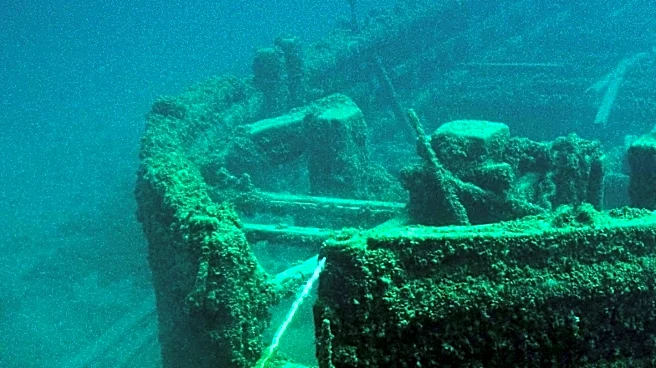
up to 100,000 sunken vessels could be scattered across the entire Baltic Sea. The Baltic Sea's unique conditions—cold, dark, brackish, and oxygen-poor waters—are exceptionally conducive to preserving wooden remains for centuries, largely due to the absence of shipworms that typically damage wrecks in saltier environments. While Swedish researchers have identified approximately 17,000 wrecks in the region, only about 200 ancient wrecks have been identified in Latvian waters, with another 200 known solely through historical records. These underwater sites represent a vast, underexplored archive offering insights into historical travel, trade, warfare, technology, and daily life. Recent underwater archaeological excavations in Lake Indzers, Latvia, have also yielded significant finds, including pottery fragments and a potentially Mesolithic bone fishing spear, demonstrating the well-preserved nature of underwater artifacts in the region.
Why It's Important?
The potential discovery and study of these numerous shipwrecks hold immense importance for understanding the historical and cultural heritage of the Baltic Sea region, including its connections to U.S. history through trade routes and migration patterns. These wrecks act as 'time capsules,' preserving detailed evidence of past societies, maritime technologies, and the goods exchanged across centuries. For Latvia, this underwater heritage offers a unique opportunity to reconstruct its past, which remains comparatively underexplored. The preservation conditions in the Baltic Sea mean that these wrecks can provide a much clearer picture of historical vessels and their contents than land-based archaeological sites. The insights gained could inform broader historical narratives, potentially revealing previously unknown aspects of European maritime history that influenced global trade and exploration, indirectly impacting the development of nations like the U.S. The lack of exploration in Latvian waters also highlights a significant gap in global archaeological knowledge.
What's Next?
The future of underwater archaeology in Latvia faces challenges, primarily due to a shortage of archaeologists trained in specialized underwater research methods. Additionally, Latvia has not yet ratified the UNESCO International Convention on the Protection of Underwater Cultural Heritage. Ratifying this convention could unlock international funding and support, which would be crucial for investigating and protecting these historical sites as more wrecks are located. Without such measures, the valuable underwater heritage remains vulnerable to looting and deterioration. Increased international collaboration and investment in training local experts will be essential to systematically explore, document, and preserve these thousands of potential archaeological sites. The ongoing efforts, such as the excavations in Lake Indzers, indicate a growing recognition of this heritage, but significant policy and resource commitments are needed to fully realize its potential.
Beyond the Headlines
The vast number of undiscovered shipwrecks in the Baltic Sea raises profound ethical and legal questions regarding ownership, preservation, and access to these submerged historical artifacts. The threat of looting, as identified by Vrak (Museum of Wrecks), underscores the urgency of establishing robust protective frameworks. Beyond the tangible historical data, these wrecks represent a unique cultural dimension, offering a silent narrative of human endeavor, tragedy, and resilience across millennia. The long-term shifts triggered by this development could include a re-evaluation of maritime history, a deeper understanding of ancient trade networks, and the development of new technologies for underwater exploration and conservation. The ethical imperative to protect these sites for future generations, coupled with the scientific potential they hold, makes the Baltic Sea a critical frontier for global archaeological research and international cooperation.