




What's Happening?
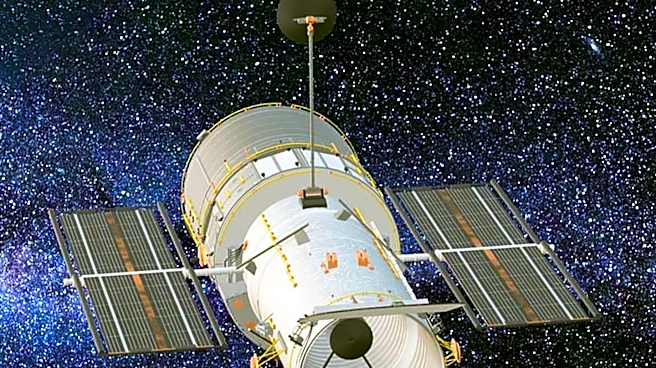
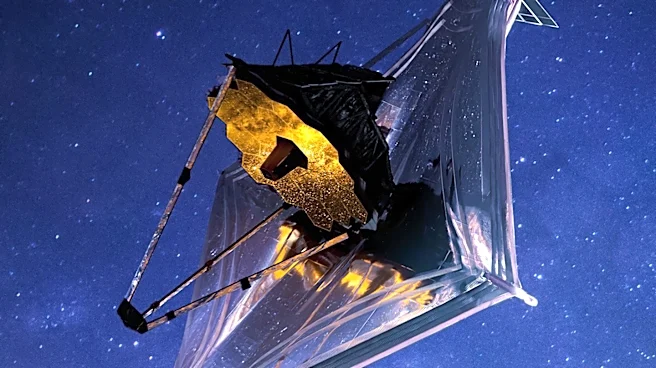
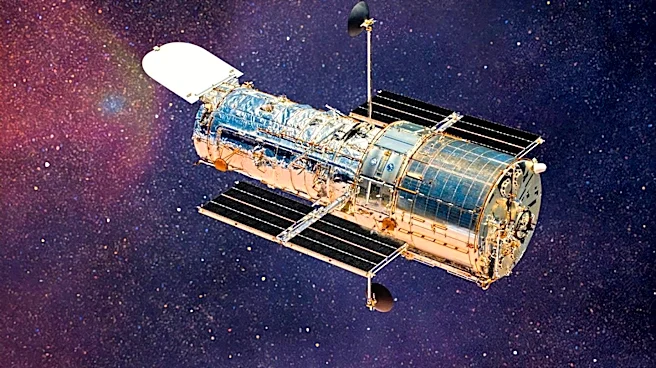
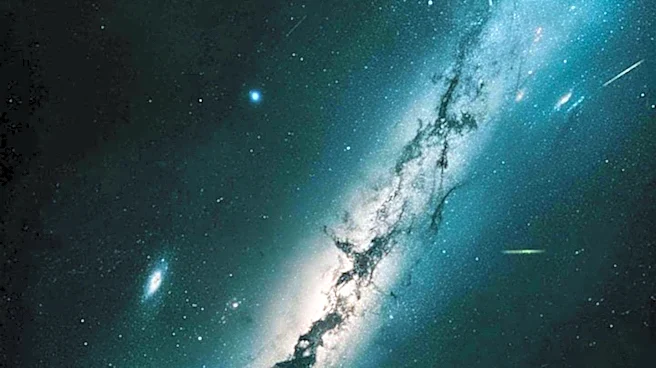
The Hubble Space Telescope and the James Webb Space Telescope (JWST) have collaborated to produce a composite image of the 'Black Eye Galaxy,' also known as Messier 64. This spiral galaxy is situated 17 million light-years from Earth in the constellation
Coma Berenices. The galaxy is notable for its unique internal motion, where the gas in its outer regions rotates in the opposite direction to the gas and stars closer to its core. To create this detailed image, astronomers combined observations from JWST, which captured near and mid-infrared wavelengths, with Hubble's data from ultraviolet, visible, and near-infrared wavelengths. This joint effort showcases the complementary capabilities of these powerful space observatories.
Why It's Important?
This collaboration between the Hubble and James Webb Space Telescopes is significant as it demonstrates the enhanced scientific potential when different advanced instruments work in concert. Each telescope offers unique observational capabilities; Hubble excels in visible and ultraviolet light, while JWST specializes in infrared. By combining their data, astronomers can achieve a more comprehensive understanding of celestial objects like the Black Eye Galaxy, revealing details that neither telescope could capture alone. This approach maximizes the scientific return from these expensive and technologically sophisticated missions, providing deeper insights into galactic structures, dynamics, and evolution. It also sets a precedent for future astronomical observations, emphasizing synergy over individual performance, especially as new observatories like the Nancy Grace Roman Space Telescope come online.
What's Next?
The successful collaboration between Hubble and JWST on the Black Eye Galaxy image is likely to encourage more joint observation campaigns in the future. As NASA's upcoming Nancy Grace Roman Space Telescope prepares for deployment, this precedent highlights how new instruments can complement existing ones rather than replace them. Astronomers will continue to analyze the composite data from the Black Eye Galaxy to further unravel its unusual rotational dynamics and star formation processes. This type of multi-wavelength imaging will be crucial for studying complex astrophysical phenomena, leading to a more complete picture of the universe. Future research may involve applying similar combined observation techniques to other galaxies and cosmic structures to gain deeper insights into their formation and evolution.
Beyond the Headlines
The combined imaging of the Black Eye Galaxy by Hubble and JWST transcends a mere photographic achievement; it represents a paradigm shift in astronomical research. This collaborative approach underscores the principle that different technological advancements, rather than rendering older ones obsolete, can synergistically enhance scientific discovery. The ability to observe the universe across a broader spectrum of light, from ultraviolet to mid-infrared, allows scientists to probe different physical processes and components within galaxies. This not only deepens our understanding of specific objects like the Black Eye Galaxy's counter-rotating gas but also contributes to a more holistic model of galactic evolution and the distribution of matter in the cosmos. Such inter-observatory cooperation fosters a more integrated and efficient use of global scientific resources, pushing the boundaries of human knowledge about the universe.