
What's Happening?
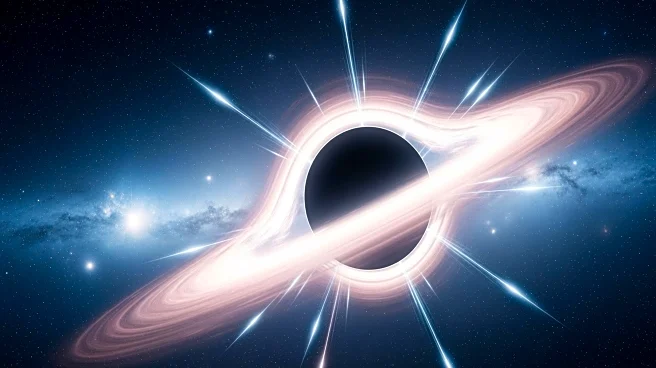
The James Webb Space Telescope (JWST) has potentially confirmed the existence of a runaway supermassive black hole, escaping its host galaxy at 2.2 million miles per hour. This discovery, led by astronomer
Pieter van Dokkum, follows decades of theoretical research on such phenomena. The black hole, with a mass of 20 million suns, leaves behind a trail of young stars stretching 200,000 light-years. JWST's observations reveal a shockwave, or bow shock, at the black hole's leading edge, providing unprecedented clarity and supporting the theory of its escape due to gravitational interactions with other black holes.
Why It's Important?
This observation marks a significant milestone in understanding the dynamics of supermassive black holes and their interactions within galaxies. The discovery provides insights into the processes that can eject black holes from their host galaxies, contributing to our knowledge of galaxy evolution and the role of black holes in shaping cosmic structures. It also demonstrates the capabilities of the JWST in observing distant and complex astronomical phenomena, paving the way for future discoveries in astrophysics.
What's Next?
The research team plans to search for more runaway supermassive black holes, using JWST's advanced capabilities to explore similar phenomena. Identifying additional examples will help refine theoretical models and enhance our understanding of black hole dynamics. The study also highlights the need for further observations to confirm the nature of these objects and their impact on galaxy formation. As JWST continues to explore the universe, it is expected to uncover more about the mysterious behaviors of supermassive black holes.