




What's Happening?
Astronomers have identified a new source of repeating radio bursts, known as ASKAP J1745, which is believed to originate from a pair of stars spiraling around each other. This discovery, published in Nature Astronomy, marks a significant advancement in understanding
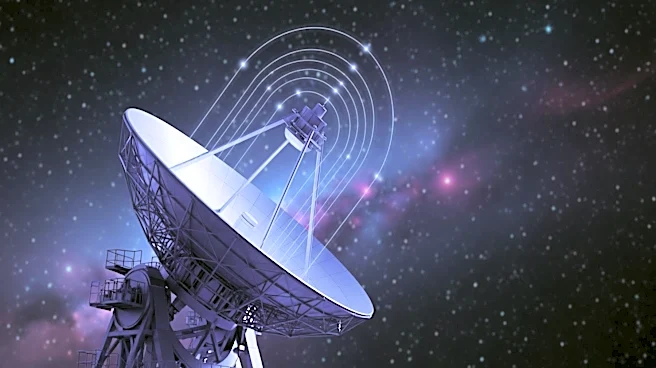
long-period transients, which are mysterious bursts of radio signals that repeat slowly. ASKAP J1745 is unique because it has been detected with multiple types of telescopes, capturing both radio and X-ray bursts with each orbit. This finding is likened to the Rosetta stone, as it provides crucial information that could help decode the origins of other long-period transients. The discovery was made using the ASKAP radio telescope, operated by CSIRO, Australia's national science agency. The system is identified as a 'cataclysmic variable,' where a white dwarf star accretes material from a companion star, leading to the observed bursts.
Why It's Important?
The identification of ASKAP J1745 is significant as it provides a new framework for understanding long-period transients, which have puzzled astronomers for years. These transients are important for studying extreme physics, such as plasma flows and magnetic fields, under conditions that cannot be replicated on Earth. The discovery of ASKAP J1745, with its detailed observations across different wavelengths, offers a new laboratory for exploring these phenomena. This could lead to advancements in our understanding of stellar evolution and the behavior of binary star systems. Additionally, the ability to detect and analyze these signals could improve our knowledge of the universe's structure and the processes occurring within it.
What's Next?
Future research will likely focus on observing more long-period transients to determine if they share similar characteristics with ASKAP J1745. This could involve using a combination of radio, X-ray, and optical telescopes to gather comprehensive data on these phenomena. The insights gained from ASKAP J1745 may guide astronomers in identifying other accreting binary systems and understanding the mechanisms behind their radio and X-ray emissions. Continued study of these systems could also enhance our understanding of the role of magnetic fields and plasma interactions in the universe.
Beyond the Headlines
The discovery of ASKAP J1745 highlights the importance of multi-wavelength astronomy in solving cosmic mysteries. By combining data from different types of telescopes, astronomers can gain a more complete picture of celestial phenomena. This approach could lead to breakthroughs in other areas of astrophysics, such as the study of neutron stars and black holes. Additionally, the findings underscore the potential for international collaboration in astronomy, as researchers from various countries and institutions work together to unravel the complexities of the universe.