



What's Happening?
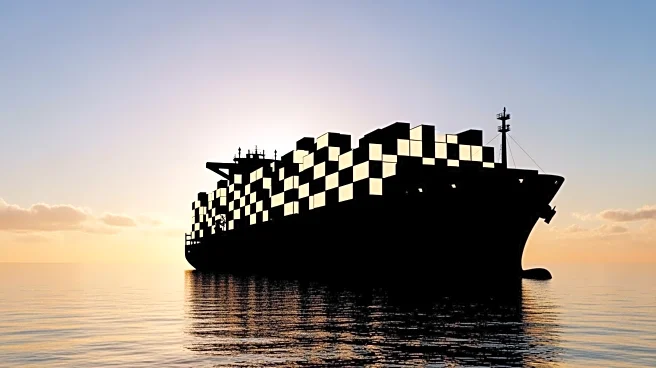
French shipping giant CMA CGM has announced the launch of its 400th owned vessel, marking a significant milestone in its growth strategy. The new ship, named CMA CGM Monte Cristo, is the first in a series of methanol dual-fuel vessels, reflecting the company's
commitment to integrating advanced technologies for enhanced environmental and operational performance. With a fleet of over 650 vessels, CMA CGM is on track to surpass Maersk as the second-largest global container carrier. The company currently operates in more than 420 ports across five continents and transported over 23 million TEU in 2024. According to Alphaliner, CMA CGM's fleet capacity is 4,155,811 TEU, just 11.5% behind Maersk's 4,629,755 TEU. The French carrier has a robust order book with 147 vessels, adding an additional capacity of 1,870,454 TEU, compared to Maersk's 79 vessels with 1,033,434 TEU capacity.
Why It's Important?
CMA CGM's expansion is significant in the global shipping industry, as it challenges the dominance of Maersk and MSC Mediterranean Shipping Company. The introduction of methanol dual-fuel vessels aligns with global efforts to reduce carbon emissions in maritime transport, positioning CMA CGM as a leader in sustainable shipping practices. This move could influence other carriers to adopt similar technologies, potentially accelerating the industry's transition to greener energy sources. The expansion also reflects the growing demand for shipping services, driven by global trade and economic activities. As CMA CGM increases its capacity, it could offer more competitive rates and services, impacting global supply chains and logistics operations.
What's Next?
CMA CGM plans to continue its fleet expansion, with a goal of operating around 200 dual-fuel LNG and methanol-fueled containerships by 2031. This strategy not only aims to increase its market share but also to meet environmental regulations and customer demands for sustainable shipping solutions. The company's focus on methanol as a primary fuel could set a precedent for future vessel designs and fuel choices in the industry. Stakeholders, including port authorities and environmental groups, will likely monitor the impact of these new vessels on emissions and port operations. As CMA CGM approaches Maersk's capacity, competitive dynamics in the shipping industry may shift, potentially leading to strategic alliances or further innovations in shipping technologies.