
What's Happening?
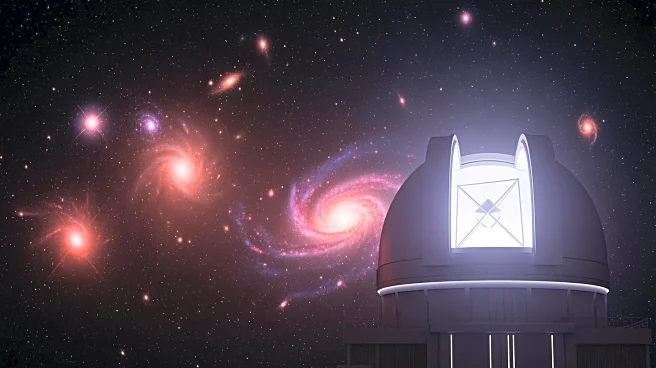
NASA's SPHEREx space telescope has completed its first infrared map of the entire sky, capturing 102 colors invisible to the human eye. This comprehensive mapping allows scientists to explore the distribution
of galaxies and cosmic features, providing insights into the universe's evolution since the big bang. SPHEREx's data will help study how galaxies have changed over time and the distribution of life-essential elements in our galaxy. The mission, managed by NASA's Jet Propulsion Laboratory, will continue to conduct additional all-sky scans to enhance data sensitivity.
Why It's Important?
The SPHEREx mission represents a significant advancement in astrophysics, offering a new perspective on the universe's structure and history. By mapping the sky in multiple infrared wavelengths, SPHEREx provides valuable data for understanding cosmic phenomena and the conditions that led to the formation of galaxies and life. The mission's findings have the potential to inform future research and exploration efforts, contributing to our knowledge of the universe and the search for extraterrestrial life.
What's Next?
SPHEREx will continue its mission by conducting three more all-sky scans, which will be combined to increase the sensitivity of its measurements. The data collected will be made available to scientists and the public, fostering further research and discovery. The mission's ongoing efforts will support NASA's broader goals of exploring the universe and understanding its origins, with potential implications for future space missions and scientific advancements.