
What's Happening?
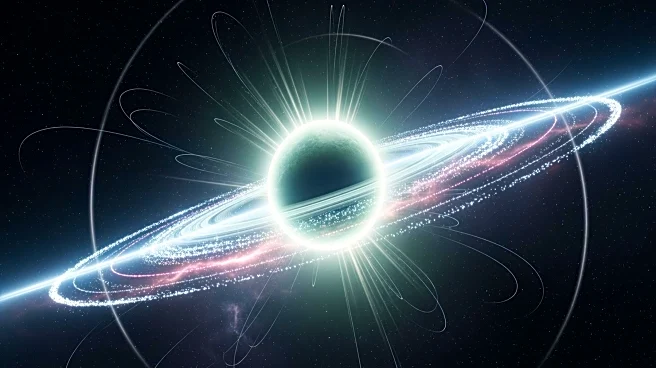
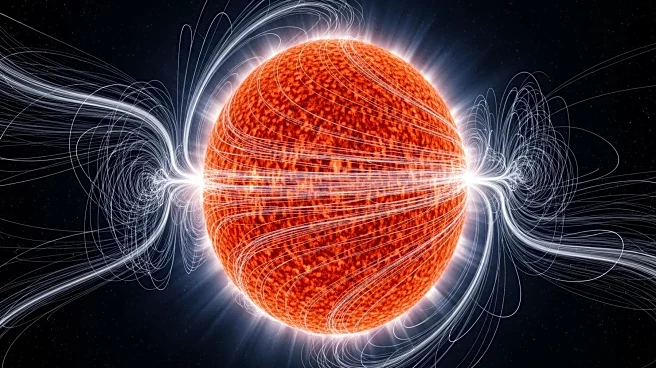
Astronomers have successfully mapped the Sun's outer 'edge,' known as the Alfvén surface, which plays a crucial role in generating the solar wind and influencing space weather on Earth. This boundary marks the point where the speed of material escaping
the Sun exceeds the speed of local magnetic waves, allowing it to stream past planets as solar wind. The Parker Solar Probe, along with other spacecraft, has been instrumental in this research, diving into the Sun's corona and crossing the Alfvén surface multiple times. The study, led by Sam Badman from the Center for Astrophysics, used data from these spacecraft to create a theoretical map of the Alfvén surface, revealing its dynamic and shifting nature. The findings, published in Astrophysical Journal Letters, show that the boundary is highly asymmetric and changes with the solar cycle, becoming more distorted toward solar maximum.
Why It's Important?
Understanding the Alfvén surface is vital for predicting space weather, which can have significant impacts on Earth's technological systems, including satellites and power grids. The solar wind forms the background through which all space-weather events propagate, and accurate mapping of this boundary can improve forecasts of solar storms. Additionally, the study suggests that the Alfvén surface can be farther from the Sun than previously thought, which has implications for the Sun's rotational dynamics and its overall history. This research not only enhances our understanding of the Sun but also provides insights into the evolution of stars in general.
What's Next?
Future research will likely focus on further refining the map of the Alfvén surface and understanding its implications for space weather prediction. Scientists may also explore the effects of coronal mass ejections (CMEs) on the solar wind and their potential to create long-lasting wakes. As the Parker Solar Probe continues its mission, more data will be collected to enhance our understanding of the Sun's magnetic environment and its influence on the solar system.