






What's Happening?
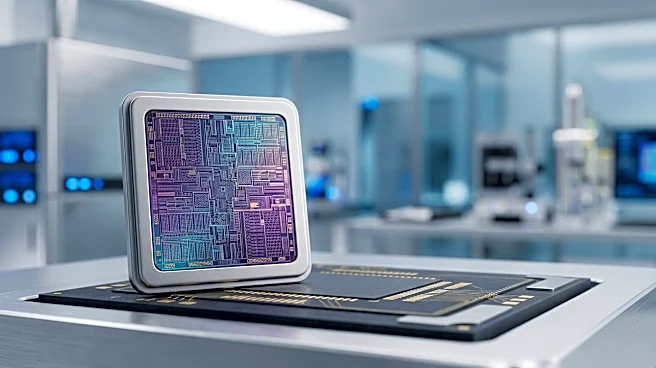
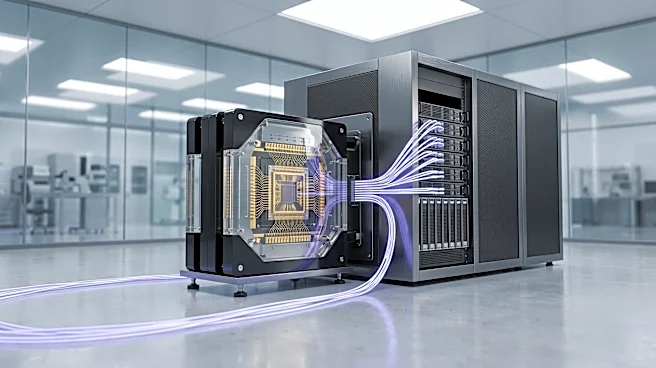
IonQ plans to install its Superion 256 quantum computer at Nvidia's Accelerated Quantum Research Center (NVAQC) in 2027. This installation will mark the first on-premises quantum processing unit (QPU) at the facility. The Superion 256 is expected to connect
directly to an Nvidia GB200 NVL72 system via NVQLink, with CUDA-Q software coordinating workloads between the quantum processor and GPU infrastructure. This setup is designed to create a defined architecture for testing hybrid quantum-GPU computing, focusing on research areas such as portfolio optimization, risk modeling, materials science, computational chemistry, and broader quantum-GPU software development. Nvidia's NVAQC was established with the vision that quantum processors will complement, rather than replace, classical supercomputers.
Why It's Important?
This collaboration between IonQ and Nvidia is a significant step towards integrating quantum computing with existing high-performance computing infrastructure. The deployment of a physical QPU at NVAQC will provide a crucial testbed for evaluating the practical utility of hybrid quantum-classical systems. It aims to demonstrate how a connected QPU can enhance GPU-only computing, potentially unlocking new capabilities for complex problem-solving across various scientific and industrial domains. The success of this integration could accelerate the commercial adoption of quantum technologies by providing a clearer pathway for enterprises to leverage quantum advantage. It also highlights the ongoing efforts to address the challenges of connecting and coordinating quantum and classical systems, which is vital for the scalability and real-world application of quantum computing.
What's Next?
The primary focus following the installation in 2027 will be to produce repeatable results that clearly demonstrate the performance benefits of the hybrid quantum-GPU configuration. Researchers will need to benchmark end-to-end latency, throughput, reliability, and error management behavior, comparing them against GPU-only baselines. While the architecture is defined, the performance case is yet to be fully validated. Enterprise teams will be closely watching for operational data, including QPU-to-GPU transfer overhead, sustained reliability, and power requirements. This deployment is part of a broader trend to bring QPUs closer to conventional compute environments, with other projects also exploring how quantum hardware fits into existing infrastructure, such as Diraq's deployment in an Equinix data center.
Beyond the Headlines
The integration of quantum computers with classical supercomputers represents a fundamental shift in the computing landscape, moving towards a hybrid model where each technology excels at different types of problems. This convergence could lead to the development of entirely new computational paradigms and algorithms, pushing the boundaries of what is currently possible. It also underscores the strategic importance of partnerships between quantum hardware developers and established computing giants like Nvidia. The insights gained from this collaboration could influence future investments in quantum research and development, shape industry standards for hybrid computing, and ultimately accelerate the timeline for achieving widespread quantum advantage across various sectors, from scientific discovery to national security.