






What's Happening?
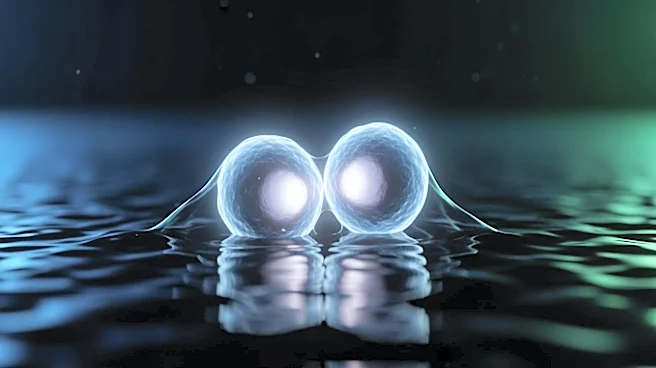
Researchers have observed a significant interaction between Asgard archaea and bacteria, which may have led to the evolution of complex life forms on Earth. Asgard archaea, named after Norse gods, are considered the closest relatives to eukaryotes, the complex cells
that make up plants and animals. The study, published in Current Biology, highlights how these ancient microbes formed a partnership, sharing resources and physically interacting, which could have led to the first eukaryotes. This discovery was made using microbial mats from Shark Bay, Australia, where researchers established cultures of these ancient microbes. The study utilized electron cryotomography to observe the interaction at a nanometre scale, revealing tiny nanotubes connecting the two organisms.
Why It's Important?
This discovery provides crucial insights into the origins of complex life on Earth, potentially reshaping our understanding of evolutionary biology. By identifying the interaction between Asgard archaea and bacteria, scientists can better understand the processes that led to the development of eukaryotic cells, which are fundamental to all complex life forms. This research not only advances scientific knowledge but also highlights the importance of preserving unique ecosystems like Shark Bay, which hold valuable clues to Earth's evolutionary history. The integration of Indigenous knowledge in naming the new microbe underscores the cultural significance of these findings.
What's Next?
Future research may focus on further exploring the genetic and biochemical interactions between Asgard archaea and bacteria to understand the mechanisms that led to complex life. Scientists may also investigate other ancient ecosystems to uncover additional clues about the evolution of life on Earth. Conservation efforts in Shark Bay could be strengthened to protect this unique environment from global changes, ensuring that it continues to provide insights into our planet's past.
Beyond the Headlines
The study bridges Western science with Indigenous knowledge, recognizing the cultural and environmental significance of Shark Bay. By naming the new microbe using the Malgana language, researchers have created a meaningful connection between scientific discovery and Aboriginal heritage. This approach highlights the importance of integrating diverse perspectives in scientific research, fostering a deeper understanding of the natural world.