
What's Happening?
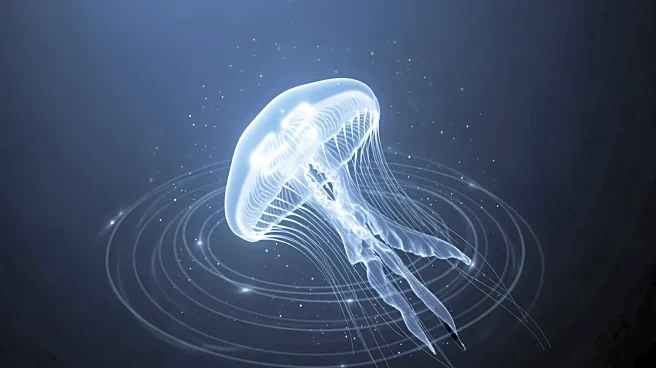
The jellyfish species Turritopsis dohrnii, found in tropical waters, has the unique ability to reverse its life cycle, effectively cheating death. This species, first discovered in 1883, can rejuvenate
itself when faced with environmental or physical stresses, such as starvation. The process involves the transformation of its cells into new types, allowing the adult medusa to revert to a polyp stage, a process known as transdifferentiation. This transformation can occur in as little as 24 to 36 hours and has been observed to happen multiple times over a two-year period. The jellyfish's ability to rejuvenate itself is linked to the activation of genes involved in stem cell maintenance and DNA repair, showcasing an extreme example of cellular plasticity.
Why It's Important?
The rejuvenation capabilities of Turritopsis dohrnii could provide significant insights into human longevity and healthspan. According to Michael Layden, a professor of biological sciences, understanding the jellyfish's mechanisms may lead to novel strategies for developing therapies to treat damaged tissues and organs. The jellyfish's ability to transform its cells offers a real-life example of self-healing, which could inspire advancements in biomedical research. The study of T. dohrnii's genetic and epigenetic networks may also shed light on fundamental processes crucial to humans, such as genome maintenance, aging, and tissue regeneration. This research could potentially lead to breakthroughs in stem cell therapeutics and regenerative medicine.
What's Next?
Future research will likely focus on further understanding the genetic mechanisms that allow Turritopsis dohrnii to rejuvenate itself. Scientists aim to explore how these processes can be applied to human health, particularly in developing therapies for tissue regeneration and aging. The jellyfish's ability to reprogram its cells could inspire new approaches in stem cell research, potentially leading to innovative treatments for age-related diseases and injuries. As researchers continue to study this species, they may uncover more about the genetic and cellular processes that enable such remarkable biological feats.
Beyond the Headlines
The study of Turritopsis dohrnii not only has implications for human health but also raises questions about the adaptability of life forms to changing environmental conditions. The jellyfish's ability to rejuvenate itself may have evolved as a response to environmental stresses, highlighting the resilience of certain species. This research could contribute to a broader understanding of how organisms adapt to their environments and the potential for similar mechanisms in other species. Additionally, the jellyfish's cellular plasticity challenges traditional views on cell differentiation, suggesting that cells may have more flexibility than previously thought.