



What's Happening?
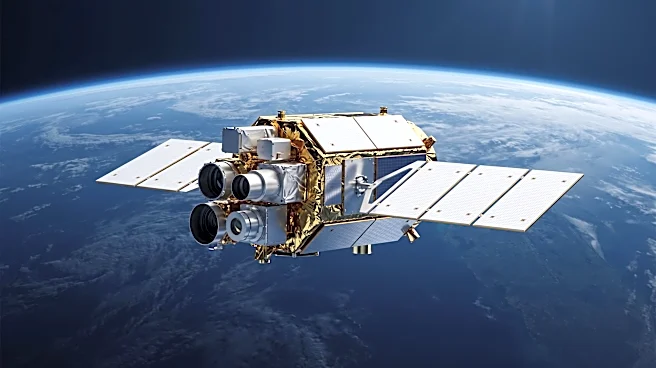
NASA’s TRACERS (Tandem Reconnection and Cusp Electrodynamics Reconnaissance Satellites) mission has provided its initial findings on how space weather influences Earth’s magnetic field. The mission, which launched two spacecraft last year, aims to study
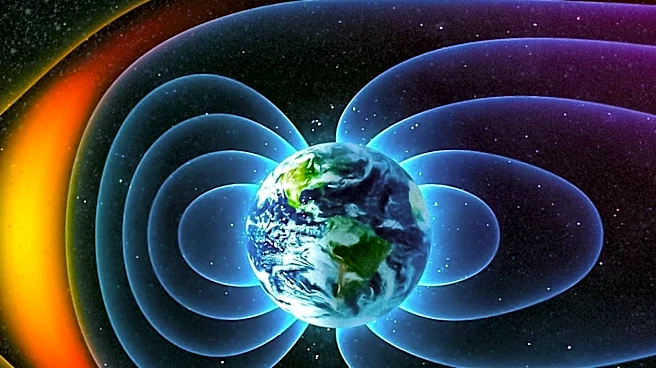
magnetic reconnection, an explosive process where the Sun’s magnetic field, embedded in the solar wind, collides with Earth’s magnetosphere. Researchers analyzed data from the first year of the mission, focusing on the behavior of solar wind particles and their connection to reconnection events. According to Stephen Fuselier, TRACERS deputy principal investigator, the data offers a clearer view of these interactions. The study, published in the Journal of Geophysical Research, indicates that magnetic reconnection is largely a spatial process, meaning the location of reconnection events moves rather than changing in time. The TRACERS satellites orbit through polar cusps, regions where solar wind particles are funneled into Earth’s upper atmosphere, allowing for repeated measurements of reconnection events.
Why It's Important?
Understanding magnetic reconnection is critical for predicting space weather, which can have significant impacts on Earth. Geomagnetic storms, caused by these interactions, can disrupt power grids, communication systems, and pose risks to astronauts. The TRACERS mission's findings, particularly that reconnection is primarily a spatial process, provide fundamental insights into how energy is transferred during these events and how the magnetopause (the edge of Earth’s magnetic field) reacts. This knowledge is essential for developing more accurate models of space weather, enabling better preparedness and mitigation strategies for potential disruptions. The ability to differentiate between spatial and temporal changes in reconnection events refines our understanding of this complex phenomenon, ultimately contributing to the safety of critical infrastructure and human space exploration.
What's Next?
The TRACERS team plans to continue collecting and analyzing data to confirm these initial results and further explore the mysteries of magnetic reconnection. With a prime mission extension approved until spring 2027, the spacecraft will routinely observe the southern cusp several times a day. Future measurements will aim to provide more detailed information on how quickly reconnection changes and evolves, comparing data between the twin satellites. This ongoing research will contribute to a more comprehensive understanding of the fundamental linkage between solar wind and Earth’s space environment, leading to improved predictions of geomagnetic storms and their potential effects on Earth-based technologies and space missions.
Beyond the Headlines
The TRACERS mission exemplifies the long-term commitment of space agencies like NASA to understanding fundamental processes that affect our planet and technological infrastructure. Beyond the immediate scientific findings, such missions foster international collaboration and technological innovation in spacecraft design and data analysis. The study of space weather also highlights the interconnectedness of the Sun-Earth system, demonstrating how events millions of miles away can have tangible consequences on our daily lives. This continuous pursuit of knowledge in heliophysics not only protects our assets but also expands our understanding of the broader cosmic environment and the forces that shape planetary systems.