


What's Happening?
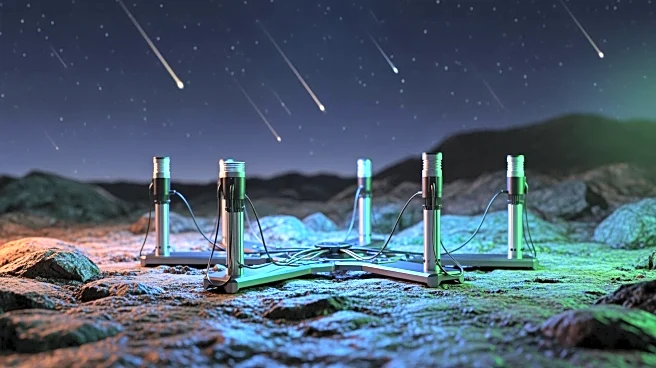
Researchers from Johns Hopkins University and Imperial College London have developed a new method to track space debris reentry using earthquake sensors. This innovative approach aims to provide real-time information about the location of space debris fragments
as they fall back to Earth. Traditionally, space debris paths are predicted using a global network of radars and optical telescopes, but these methods have limitations, especially when debris interacts with the atmosphere. The new method leverages seismic sensors, which are widely distributed and can detect sonic booms from reentering debris. This technique was tested on a piece of debris from China's Shenzhou 17 crew capsule, revealing its trajectory over California, contrary to initial predictions.
Why It's Important?
The ability to accurately track space debris is crucial for public safety and environmental protection. Space debris poses a risk to populated areas and can cause significant disruptions, as seen in a 2022 incident when airspace was closed in Europe due to debris concerns. The new method could reduce the time needed to locate debris fragments, minimizing potential hazards. Additionally, understanding the reentry process helps assess the risk posed by debris to people, property, and aircraft. This method could also provide insights into how much debris survives reentry, challenging claims by companies like SpaceX about the complete disintegration of their satellites.
What's Next?
Future studies aim to expand the tracking capabilities by incorporating acoustic sensor networks, which can detect reentry events over larger areas, including oceans where radar data is sparse. This could enhance the ability to monitor debris from megaconstellations like SpaceX's Starlink. The research team plans to further refine the method to improve accuracy and coverage, potentially leading to better global tracking systems for space debris.