



What's Happening?
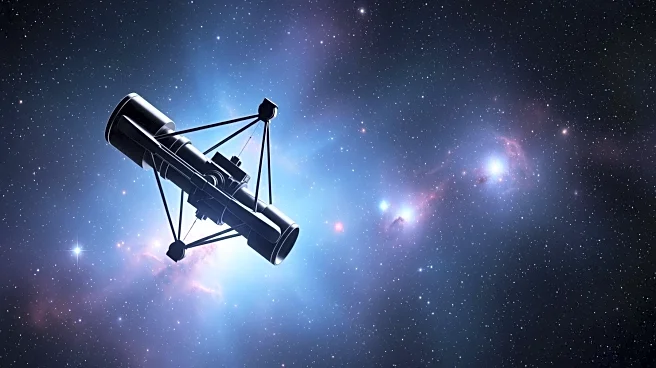
NASA's Nancy Grace Roman Space Telescope is set to revolutionize the study of cosmic voids, which are vast, empty regions in space with few galaxies. These voids are crucial for understanding the universe's expansion history. The Roman Telescope will
measure these voids with unprecedented precision, providing insights into the distribution of galaxies and the nature of dark energy and dark matter. The telescope's High-Latitude Wide-Area Survey will detect tens of thousands of cosmic voids, allowing scientists to use statistical methods to analyze their shapes and the influence of cosmic components. This research aims to refine cosmological models and enhance our understanding of the universe's makeup.
Why It's Important?
The study of cosmic voids is significant as it offers a unique perspective on dark energy, a mysterious force driving the universe's accelerated expansion. By analyzing voids, scientists can impose constraints on dark energy's properties, potentially leading to breakthroughs in cosmology. The Roman Telescope's ability to observe faint and distant galaxies will provide a more comprehensive view of these voids, contributing to a deeper understanding of the universe's structure. This research could impact theoretical physics and cosmology, influencing how scientists model the universe's evolution and the fundamental forces at play.
What's Next?
The Roman Telescope's High-Latitude Wide-Area Survey will commence, focusing on areas away from the Milky Way's plane. Researchers will gather data on galaxy positions and redshifts to map voids in three dimensions. This data will be crucial for testing and refining cosmological models. The scientific community anticipates that the findings will prompt further studies and collaborations, potentially leading to new theories about dark energy and the universe's expansion. The telescope's observations will also complement other missions, such as ESA's Euclid, enhancing the overall understanding of cosmic structures.