




What's Happening?
The environmental documentary 'The Lake,' directed by Abby Ellis, is being screened across Utah to raise awareness about the critical condition of the Great Salt Lake. The film, which premiered at the Sundance Film Festival, follows microbiologist Bonnie
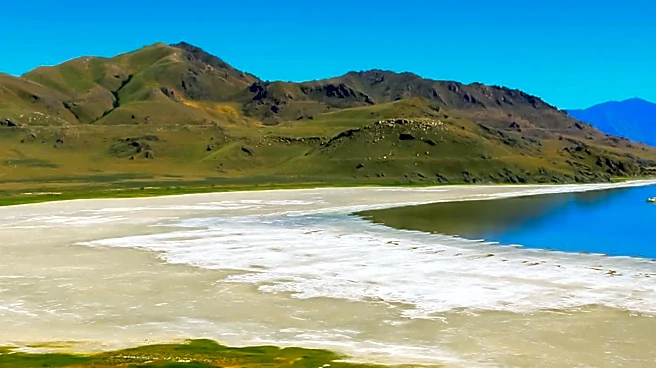
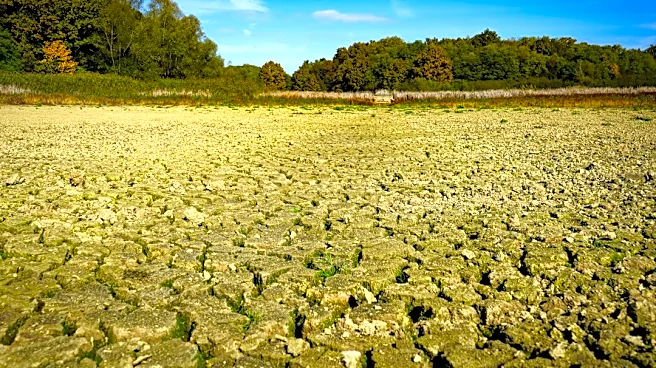
Baxter, ecologist Ben Abbott, and former Great Salt Lake commissioner Brian Steed, among others, in their conservation efforts. Screenings, like the one at the Historic Bicknell Theater hosted by Grow the Flow, aim to educate the public on the impending environmental catastrophe if the lake continues to shrink. Kevin Perry, a professor of atmospheric sciences featured in the film, discussed the increasing threat of arsenic in the dust from the drying lakebed and the expansion of dust monitors to affected communities. The film's tone has shifted from dire predictions of collapse by 2023 to a more optimistic outlook, emphasizing that there is still hope if collective action is taken.
Why It's Important?
The crisis of the Great Salt Lake, as highlighted by 'The Lake' documentary, has significant environmental and public health implications for the U.S. The shrinking lake exposes toxic dust containing arsenic, posing severe health risks to residents in the Salt Lake Valley and Wasatch Front. This situation underscores the broader challenges of climate change and water management in the American West, impacting agriculture, industry, and urban development. The film's outreach efforts are crucial for mobilizing public support and political will for conservation policies, which could serve as a model for other regions facing similar environmental threats. For U.S. businesses, the crisis presents both challenges (e.g., impact on local industries) and opportunities (e.g., development of water conservation technologies, environmental monitoring solutions).
What's Next?
The documentary 'The Lake' will continue its screenings across Utah, with organizations like Grow the Flow aiming to keep it in theaters to maximize public education and engagement. The goal is to encourage widespread participation in conservation efforts and pressure policymakers to implement effective solutions. The state of Utah has already set a goal to achieve healthy lake levels by 2034, coinciding with Salt Lake City's potential hosting of the Winter Olympics. Continued funding for dust monitors and the expansion of monitoring stations are expected. The film's ongoing impact will depend on its ability to translate increased awareness into sustained civic action and policy changes to protect the Great Salt Lake.
Beyond the Headlines
Beyond the immediate environmental concerns, 'The Lake' delves into the complex interplay of science, politics, and faith in addressing ecological crises. The film touches upon Governor Cox's encouragement of prayer and fasting for rain, alongside scientific conservation efforts, highlighting the diverse approaches to environmental challenges in the U.S. The narrative also explores the psychological aspect of environmental crises, moving from initial despair to a hopeful call for action, emphasizing that human intervention can still avert catastrophe. This blend of scientific data, political action, and community engagement, as depicted in the documentary, offers a nuanced perspective on how societies grapple with large-scale environmental threats and the role of storytelling in fostering collective responsibility.