






What's Happening?
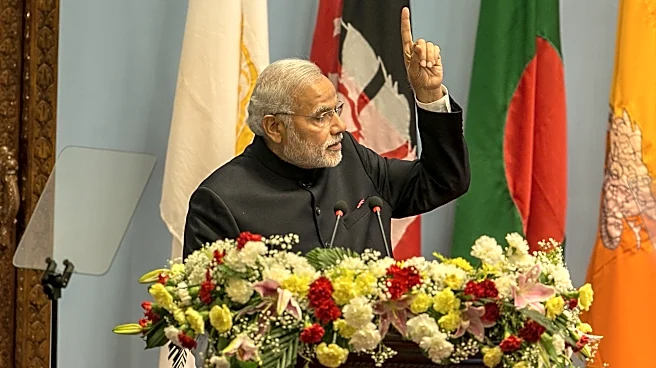
Prime Minister Narendra Modi announced that his government's initiative to open India's space sector to private entities has empowered young individuals to innovate and engage in space-related activities previously unseen in the country. Speaking at the inauguration
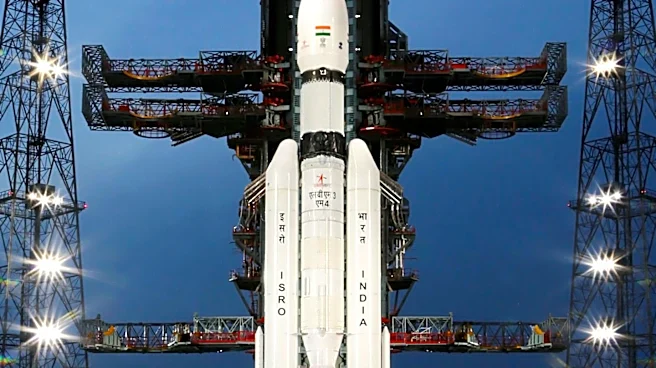
of the COSMOS-Mysuru Planetarium in Karnataka, Modi emphasized the significant strides India has made in its space program, including advancements in solar observation, space docking capabilities, and human spaceflight. He cited successful missions such as Aditya-L1, India's first space-based solar observatory, and Chandrayaan-3, which achieved a historic landing near the Moon's south pole. Modi also highlighted India's achievement as the fourth nation to demonstrate space docking and undocking capabilities. Furthermore, he noted the practical applications of space technology in various public services, such as satellite communication systems for fishermen, real-time train tracking, and crop yield estimation for insurance claims under the Pradhan Mantri Fasal Bima Yojana. The Prime Minister underscored that these developments are not only pushing the boundaries of space exploration but also directly improving the lives of citizens on Earth.
Why It's Important?
The opening of India's space sector to private players signifies a pivotal shift in the nation's approach to scientific and technological development. This policy change is crucial for fostering innovation, creating new economic opportunities, and engaging a younger demographic in advanced scientific fields. By enabling private companies and startups to participate, India is diversifying its space capabilities beyond traditional government-led initiatives, potentially accelerating the pace of technological advancement and reducing development costs. The emphasis on practical applications of space technology demonstrates a commitment to leveraging scientific progress for societal benefit, directly impacting sectors like agriculture, transportation, and disaster management. This strategic direction could position India as a more competitive player in the global space economy, attracting international collaborations and investments. The increased youth involvement also ensures a sustainable pipeline of talent for future scientific and technological endeavors, reinforcing India's long-term growth prospects in these critical areas.
What's Next?
Following the successful opening of the space sector, India is expected to see continued growth in private sector involvement, with more startups and companies developing and launching their own rockets and satellites. The government's ongoing support for these initiatives, coupled with the establishment of advanced facilities like the COSMOS-Mysuru Planetarium, will likely further stimulate scientific curiosity and innovation among young people. Future missions, including the Gaganyaan human spaceflight program, will continue to build on the experience gained from international collaborations and experiments. The integration of space technology into everyday services is also anticipated to expand, leading to more efficient and data-driven solutions in various public and private sectors. Continued investment in research and development, along with policies that encourage private participation, will be key to sustaining this momentum and achieving India's ambitious goals in space exploration and technology utilization.
Beyond the Headlines
The strategic decision to liberalize India's space sector extends beyond mere technological advancement; it represents a broader vision for national development and global positioning. By democratizing access to space technology, India is fostering a culture of innovation and entrepreneurship that could have ripple effects across other high-tech industries. This approach also challenges traditional models of state-controlled space programs, potentially inspiring other nations to explore similar public-private partnerships. Ethically, the dual use of space technology for both exploration and societal benefit highlights a commitment to responsible scientific progress. The emphasis on youth engagement is critical for long-term national capacity building, ensuring that India remains at the forefront of scientific discovery and technological application. This shift could also lead to a more collaborative global space environment, as India's private sector seeks international partners and markets, further integrating the nation into the global scientific and economic landscape.