









What's Happening?
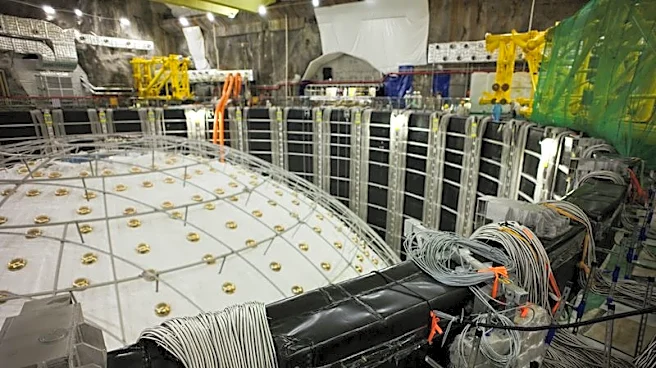
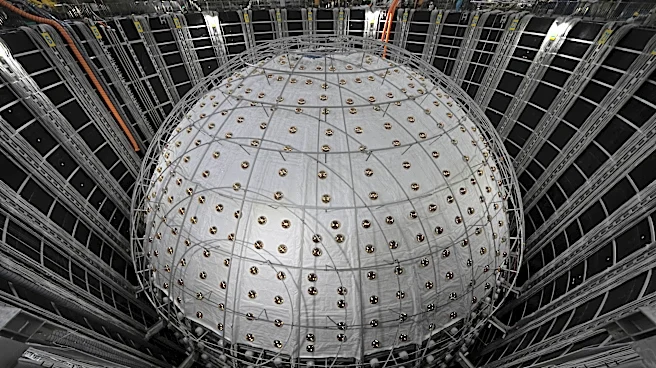
The Jiangmen Underground Neutrino Observatory (JUNO) in China has released its first major findings on neutrinos, the elusive particles that permeate the universe. Located 2,297 feet underground, the JUNO detector has been collecting data since August,
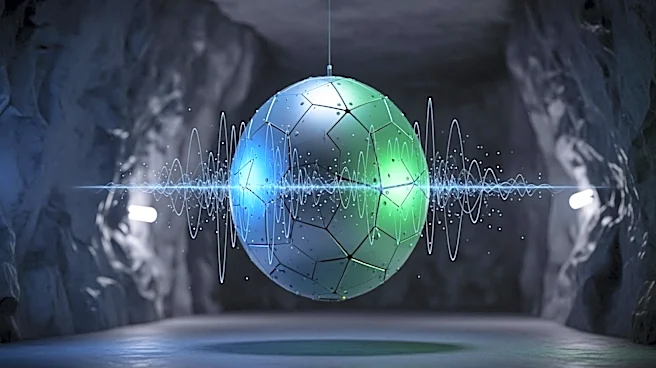
focusing on antineutrinos from nearby nuclear power plants. The initial results provide precise measurements of how neutrinos switch between three varieties, or flavors, as they travel through space. These findings are significant in the quest to understand the mass and behavior of neutrinos, which are fundamental to the universe's structure. The research, published in Nature, highlights the detector's capability to test the subtle differences in neutrino flavors and masses.
Why It's Important?
Understanding neutrinos is crucial for advancing knowledge in particle physics and cosmology. Neutrinos, which date back to the Big Bang, play a key role in the universe's evolution. The JUNO detector's findings contribute to resolving the mystery of neutrino mass hierarchy, a fundamental question in physics. The research could lead to breakthroughs in understanding the universe's fundamental forces and particles. Additionally, the results will be cross-verified by upcoming neutrino detectors in Japan and the United States, enhancing the reliability of the findings. This collaborative effort underscores the global scientific community's commitment to unraveling the mysteries of the universe.