


What's Happening?
A new study has provided insights into the formation of the King's Trough complex, a vast network of trenches and basins located approximately 1,000 kilometers off the coast of Portugal. Known as the 'Grand Canyon of the Atlantic,' this underwater feature
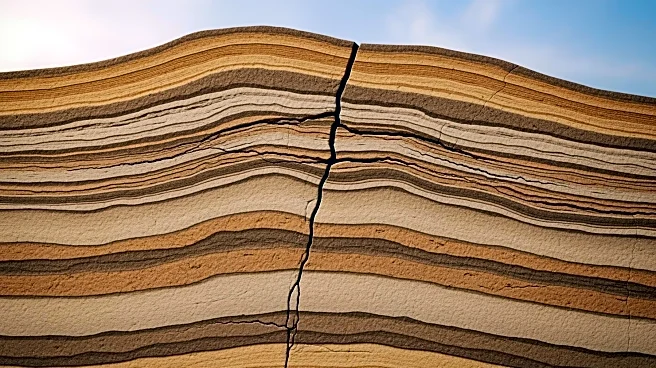
extends about 500 kilometers across the seafloor. Researchers from the GEOMAR Helmholtz Centre for Ocean Research in Germany have identified that the complex was formed due to a combination of weakening from heat generated by an existing mantle plume and immense pressure from a temporary plate boundary. This study utilized high-resolution sonar mapping and volcanic rock sample analysis to determine the age and origin of the trough, placing its creation between 37 and 24 million years ago. The findings suggest that tectonic processes, specifically movements of the Earth's crust, played a central role in the development of this remarkable structure.
Why It's Important?
The study's findings are significant as they provide a clearer understanding of the geological processes that shape the ocean floor. The King's Trough complex serves as a case study for how mantle plumes and tectonic activity can interact to form large-scale underwater features. This research not only enhances scientific knowledge of the Atlantic seafloor but also offers insights into similar geological formations worldwide. Understanding these processes is crucial for geologists and oceanographers as it can inform future studies on tectonic activity and its impact on oceanic structures. Additionally, the study highlights the importance of advanced technologies, such as high-resolution sonar and geochemical analysis, in uncovering the history and dynamics of Earth's geological features.
What's Next?
The study opens avenues for further research into the King's Trough complex and similar underwater formations. Scientists may focus on comparing the King's Trough with other trench systems, such as the Terceira Rift in the Azores, to understand the similarities and differences in their formation processes. Future studies could also explore the implications of these findings for understanding the broader tectonic and volcanic activity in the Atlantic region. Additionally, the research may prompt further investigation into the role of mantle plumes in shaping the Earth's crust, potentially leading to new discoveries about the planet's geological history.
Beyond the Headlines
The study of the King's Trough complex also raises questions about the long-term impact of tectonic and volcanic activity on marine ecosystems. Understanding the formation and evolution of such underwater features can provide insights into the habitats they create and the biodiversity they support. Furthermore, the research highlights the interconnectedness of geological processes across different regions, as the mantle plume identified in the study is linked to the active Azores mantle plume. This interconnectedness underscores the complexity of Earth's geological systems and the need for comprehensive studies to unravel their mysteries.