






What's Happening?
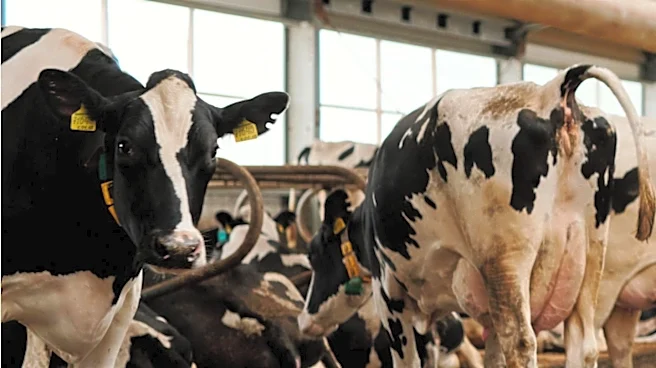
A new study from the University of Connecticut, led by Elias Uddin, Assistant Professor of Animal Science, emphasizes the critical role of farm-specific data in accurately measuring the carbon footprint of milk production. Published in the Journal of Dairy
Science, the research, conducted at the Bangladesh Agricultural University Dairy Farm, found that using farm-specific data and Tier 2 equations from the Intergovernmental Panel on Climate Change (IPCC) resulted in a 27% lower carbon footprint estimate compared to previous generalized methods. The study also revealed that increasing cow productivity by 63% over five years led to a 37% reduction in the carbon footprint, primarily due to genetic selection and improved management strategies like balanced diets. This contrasts with traditional methods that often overestimate emissions in developing countries by not accounting for dual-purpose farming or specific allocation methods.
Why It's Important?
This study has significant implications for the U.S. dairy industry and global agricultural sustainability. Accurate carbon footprint measurement is crucial for informed decision-making, policy development, and international trade, as environmentally friendly products are increasingly preferred. The findings suggest that generalized carbon footprint calculations can be misleading, potentially misrepresenting the environmental performance of farms, especially in diverse agricultural systems. By demonstrating that increased productivity directly correlates with reduced carbon footprint, the research provides a clear pathway for dairy farmers to enhance both their economic viability and environmental stewardship. This approach encourages investment in genetic improvements and efficient farm management, which can lead to more sustainable milk production practices across the U.S. and globally.
What's Next?
The UConn study's findings are expected to encourage a shift towards more granular, farm-specific data collection and analysis in assessing the environmental impact of dairy production. Researchers and agricultural organizations will likely advocate for the adoption of more precise methodologies, such as IPCC Tier 2 equations, to provide a clearer picture of carbon footprints. This could lead to better-targeted interventions and recommendations for farmers, helping them identify and implement practices that effectively reduce emissions. Furthermore, the emphasis on productivity as a key driver for carbon footprint reduction will likely spur continued investment in genetic selection, improved nutrition, and advanced farm management techniques within the U.S. dairy sector, aiming for both efficiency and sustainability.
Beyond the Headlines
The research delves into the complexities of environmental accounting in agriculture, highlighting that 'one-size-fits-all' models can obscure true impacts and hinder progress. The concept of carbon footprint per unit of nutrient production, rather than just per unit of milk, offers a more holistic view, especially in regions where animals serve multiple purposes (e.g., dairy and meat). This nuanced understanding is vital for developing equitable and effective climate policies that support diverse farming systems. The study also underscores the growing importance of environmental performance in international commerce, suggesting that countries and producers with accurately measured and lower carbon footprints may gain a competitive advantage. Ultimately, this work contributes to a broader scientific effort to refine sustainability metrics and promote practices that are both ecologically sound and economically viable for farmers worldwide.