



What's Happening?
The Transportation Security Administration (TSA) is commemorating its 25th anniversary on November 19, marking a quarter-century of significant changes in airport security for air travelers across the United States, including those departing from El Paso
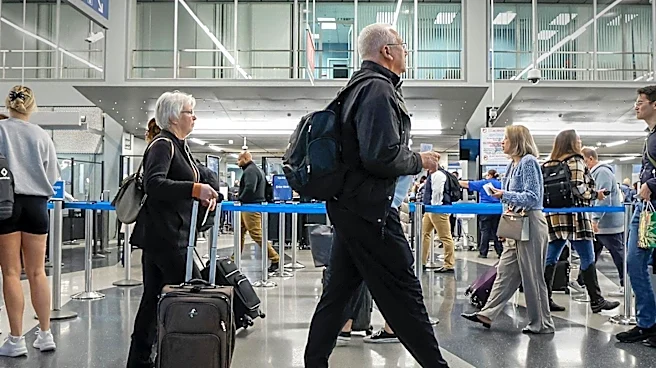
International Airport and Albuquerque International Sunport. Established in the aftermath of the September 11, 2001, terrorist attacks, the federal agency fundamentally altered the screening processes for passengers and their belongings on commercial aircraft. TSA Administrator David P. Cummins emphasized the agency's unwavering mission to prevent future terrorist attacks on the nation's transportation system. Over the past 25 years, the TSA has implemented federally operated passenger screening, advanced detection technologies, and expanded security protocols to identify potential threats before aircraft boarding. The agency continues to screen record numbers of travelers, even amidst federal government shutdowns and increased passenger traffic. Notable changes for travelers include updated screening technologies that have streamlined checkpoint procedures, such as allowing passengers to keep their shoes on during routine security screenings, a departure from post-9/11 requirements.
Why It's Important?
The TSA's 25th anniversary highlights the enduring impact of the September 11 attacks on U.S. national security and daily life, particularly for air travelers. The agency's continuous evolution in security measures underscores the ongoing effort to safeguard the nation's transportation infrastructure against evolving threats. For millions of Americans, including residents of Las Cruces, Dona Ana County, and southern New Mexico who frequently use El Paso and Albuquerque airports, TSA procedures are an integral part of the travel experience. The agency's innovations, such as One Stop Security for international connections and remote screening technology, aim to balance security imperatives with traveler convenience. These developments affect not only the aviation industry but also the broader economy by influencing travel patterns, logistics, and the public's confidence in air travel. The TSA's role extends beyond airports to other transportation systems like passenger rail, mass transit, and pipelines, indicating its critical function in comprehensive national security.
What's Next?
Looking ahead, the TSA plans to continue innovating and adapting to new security challenges, maintaining its core mission established in 2001. The agency is actively developing programs to enhance travel convenience without compromising security, such as the One Stop Security initiative designed to simplify international connections by reducing the need for additional security screenings upon U.S. arrival. Furthermore, the TSA is exploring remote screening technology, with a pilot program already introduced at Boston Logan International Airport, allowing trained personnel to review screening images off-site. The agency is also expanding its capabilities to address emerging threats, including those posed by drones and cybersecurity vulnerabilities. For travelers, especially during upcoming holiday seasons like Thanksgiving and Christmas, the TSA's anniversary serves as a reminder to plan ahead, verify identification requirements, review carry-on restrictions, and allocate sufficient time for security screening before departure. The agency's commitment to adapting and learning from past experiences suggests ongoing adjustments to security protocols and technological advancements.
Beyond the Headlines
The TSA's 25-year history reflects a significant shift in the balance between individual privacy and collective security in the United States. The post-9/11 era ushered in an unprecedented level of government oversight in personal travel, fundamentally altering the passenger experience. While these measures have been crucial in preventing further terrorist attacks, they have also sparked ongoing debates about efficiency, invasiveness, and the psychological impact of constant security checks. The agency's expansion into areas like drone threat mitigation and cybersecurity highlights the evolving nature of national security challenges, moving beyond traditional physical threats to encompass digital and aerial domains. This broader mandate signifies a recognition that modern threats are multifaceted and require a comprehensive, adaptive security apparatus. The continuous technological advancements, such as remote screening and simplified checkpoint procedures, also point to a future where security might become more integrated and less disruptive, yet the underlying tension between convenience and vigilance will likely remain a central theme in transportation security policy.