



What's Happening?
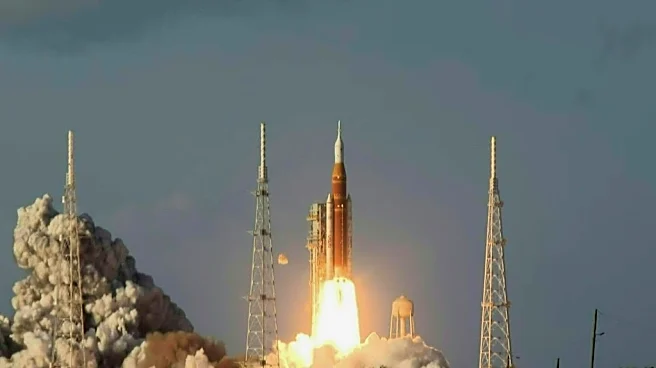
NASA's Artemis II mission, which launched from Kennedy Space Center in Florida on April 1, 2026, is currently en route to the Moon. The mission is led by Commander Reid Wiseman, Pilot Victor Glover, and Mission Specialist Christina Koch from NASA, along
with Mission Specialist Jeremy Hansen from the Canadian Space Agency. The crew is set to reach the lunar sphere of influence on April 5, before the Orion spacecraft orbits the far side of the Moon on April 6. This mission is part of NASA's broader Artemis program, which aims to explore the Moon and beyond. Daily highlights of the mission are being published to keep the public informed of its progress.
Why It's Important?
The Artemis II mission represents a significant step in human space exploration, as it aims to travel further into space than any previous human expedition. This mission is crucial for testing the life support systems and other technologies on the Orion spacecraft, which will inform future missions, including Artemis III and IV. These subsequent missions plan to test lunar landers and conduct moon landings, respectively. The success of Artemis II could pave the way for sustainable human presence on the Moon and potentially support future missions to Mars. The mission also underscores international collaboration in space exploration, with the involvement of the Canadian Space Agency.
What's Next?
Following the successful completion of Artemis II, NASA plans to proceed with Artemis III in 2027, which will involve testing lunar landers developed by SpaceX and Blue Origin. Artemis IV, scheduled for 2028, aims to achieve a moon landing. These missions will further test and refine the technologies necessary for long-term lunar exploration and habitation. The data collected from Artemis II will be critical in planning these future missions, ensuring the safety and success of astronauts as they venture further into space.